

If you own a home in Central Texas, you’ve probably wondered why your property tax bill changes from year to year. You may also wonder where that money goes and whether you’re paying more than necessary. Understanding Texas property taxes can help you make better financial decisions, whether you’re buying, selling, or staying in your current home.
As a lifelong Central Texan and real estate broker with more than 18 years of experience, I’ve watched our communities grow significantly. Along with that growth, property values and local government expenses have changed. Let’s look at how property taxes work in Texas, what your money supports, and which exemptions and laws may help reduce your bill.
Where Do Texas Property Taxes Go?
One thing that surprises some homeowners is that Texas does not have a state property tax. Instead, local governments establish and collect property taxes to fund public services. The money is distributed among different taxing entities based on where your property is located.
|
Taxing Entity |
What Your Taxes Help Fund |
|---|---|
|
School districts |
Public schools, teachers, facilities, transportation, and education programs |
|
Counties |
Sheriff’s offices, courts, county roads, public safety, and other county services |
|
Cities |
Police, fire protection, streets, parks, and municipal services |
|
Emergency services districts |
Fire protection and emergency medical services |
|
Hospital districts |
Qualifying public healthcare services and facilities |
|
Community college districts |
Higher education, facilities, and related services |
|
Municipal utility districts |
Water, wastewater, drainage, and other eligible infrastructure |
Not every property pays taxes to all these entities. For example, a home inside San Marcos city limits may have a different combination of taxing jurisdictions than a rural property outside the city. Furthermore, some newer neighborhoods have additional district taxes or assessments. We explain these differences in our article about Texas PIDs and MUDs and How They Affect Homeowners.
How Are Texas Property Taxes Calculated?
Texas property taxes are generally calculated using your property’s taxable value and the rates established by the applicable local taxing entities. Each taxing entity sets its rate per $100 of taxable property value. For example, consider a home with a taxable value of $400,000 and a hypothetical combined rate of $2.00 per $100.
|
Calculation |
Amount |
|---|---|
|
Taxable property value |
$400,000 |
|
Tax rate per $100 |
$2.00 |
|
Annual property tax |
$8,000 |
|
Monthly equivalent |
$666.67 |
This is an illustrative calculation, not an actual rate for a particular community. Importantly, market value, appraised value, and taxable value are not necessarily the same. Exemptions and appraisal limitations can reduce the value used to calculate taxes. Therefore, two homes with similar market values can have very different tax bills. The Texas Comptroller’s Property Tax Division explains how the statewide system operates.
Texas Property Tax Exemptions That Can Save Homeowners Money
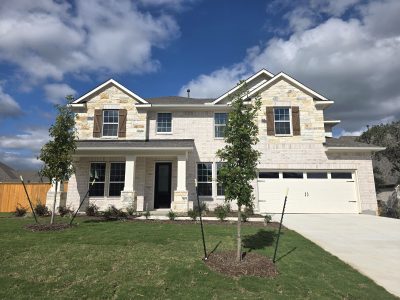
This newly built Highland Homes residence in La Cima, San Marcos, Texas, illustrates the types of homes that may qualify for Texas homestead property tax exemptions. La Cima is also located within a Public Improvement District (PID), which can add special assessments to homeownership costs.
One of the most important ways homeowners can reduce Texas property taxes is by applying for available exemptions. These exemptions reduce taxable value for qualifying property. However, not every exemption applies to every homeowner or taxing jurisdiction.
General Residence Homestead Exemption
For 2026, eligible Texas homeowners receive a $140,000 residence homestead exemption for school district property taxes. This increased from $100,000 following changes approved in 2025. If a qualifying home has a value of $400,000 before exemptions, this exemption reduces the value subject to school district taxes to $260,000. However, it does not automatically reduce taxable value for every other taxing jurisdiction.
To qualify, you generally must own the property and use it as your principal residence. Review the requirements through the Texas Comptroller’s official property tax exemptions guide.
Exemptions for Homeowners Age 65 or Older
Texas provides additional property tax benefits for qualifying homeowners age 65 or older. For 2026, eligible homeowners receive another $60,000 school district exemption, bringing their combined school homestead exemptions to $200,000. In addition, qualifying homeowners receive a school district property tax ceiling, sometimes called a tax freeze.
That ceiling generally limits future school district taxes on the qualifying homestead, although certain improvements and other statutory circumstances can affect it. Some counties and other taxing entities also offer optional exemptions or local tax ceilings. Therefore, it is worth checking what is available where you live.
Exemptions for Homeowners With Disabilities
Homeowners who meet Texas’s qualifying disability requirements may also receive an additional $60,000 school district residence homestead exemption. They may qualify for a school district tax ceiling and certain additional local benefits. However, the age 65 and disability school exemptions generally cannot be combined to claim the same additional exemption twice. Eligibility depends on the applicable requirements, so verify your qualifications with the county appraisal district.
Disabled Veterans and Surviving Spouses
Texas also offers important property tax benefits for qualifying disabled veterans and certain surviving spouses. Depending on disability rating and other circumstances, exemptions may range from partial reductions to a complete residence homestead exemption. For example, veterans receiving 100% disability compensation because of a 100% service-connected rating or individual unemployability may qualify for a full homestead exemption.
Certain surviving spouses of disabled veterans, military service members, and first responders may also qualify for special exemptions. I encourage eligible veterans and families to review the Texas Comptroller’s disabled veteran exemption information.
Other Texas Property Tax Exemptions
Additional relief may be available depending on your circumstances. Qualifying solar or wind-powered energy devices may receive an exemption for their contribution to property value. Certain disaster-damaged properties may qualify for temporary exemptions, while some local governments offer optional homestead exemptions beyond state requirements. The important thing is to verify which benefits apply to your specific property.
How to Apply for a Texas Homestead Exemption
Applying for a homestead exemption is generally straightforward, and there is no fee to file directly with your county appraisal district. The standard application is Texas Comptroller Form 50-114. Homeowners typically provide proof of ownership, identification, and any supporting documents required for their exemption. The normal application deadline is April 30, although some exemptions allow late applications. Feel free to Contact me, and I will be happy to email you a PDF of the form 50-114.
Once approved, a homestead exemption generally continues without annual reapplication unless circumstances change or the appraisal district requests updated information. Additionally, homeowners who purchase a qualifying residence during the year may be eligible for a prorated general homestead exemption under applicable rules. I recommend reviewing your exemption status every year, especially after buying a home, turning 65, or experiencing another qualifying change.
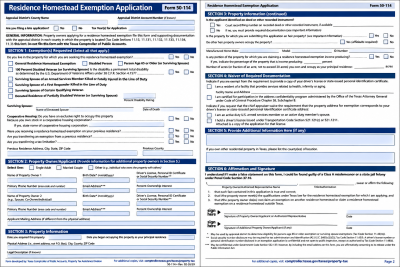
Texas Comptroller Form 50-114 is the standard application homeowners use to request residence homestead exemptions, including additional exemptions for qualifying seniors, individuals with disabilities, and disabled veterans.
Texas Laws That Help Protect Homeowners
Several Texas property tax laws provide protections and opportunities for homeowners to manage their obligations. However, understanding what those laws actually limit is important.
The 10% Homestead Appraisal Cap
Texas law generally limits annual increases in the appraised value of a qualifying residence homestead to 10%, excluding certain new improvements. For example, if a qualifying property’s capped appraised value was $300,000 last year, the next year’s capped value generally cannot exceed $330,000 without accounting for qualifying new improvements.
However, the 10% appraisal cap does not mean your property tax bill can only increase by 10%. Changes in tax rates, exemptions, and other factors can still affect your bill. In addition, the limitation applies under specific qualification and timing rules; it does not automatically protect every newly purchased home immediately.
Property Tax Ceilings and Deferrals
Qualifying homeowners age 65 or older and certain homeowners with disabilities receive school district tax ceilings. Some eligible homeowners can also apply to defer collection of property taxes on their residence homestead. A deferral may postpone collection activity while eligibility continues. However, a deferral does not eliminate the taxes owed, and interest generally continues to accrue. Homeowners should review the requirements before choosing this option.
Truth-in-Taxation Laws
Texas requires local taxing entities to provide information about proposed tax rates and follow procedures before adopting their annual rates. These requirements give property owners opportunities to review proposed rates and participate in the process. The Texas Property Tax Transparency website provides access to local tax information, including proposed rates and property-specific estimates where available.
Why Texas Property Taxes Differ Across Central Texas Counties
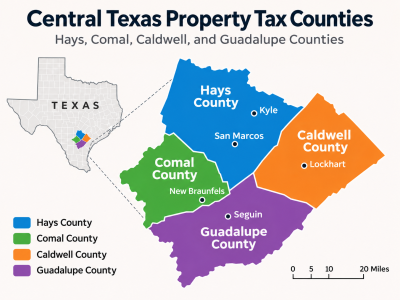
Property taxes vary across Hays, Comal, Caldwell, and Guadalupe counties. Local school districts, municipalities, special taxing districts, and exemptions all help determine a homeowner’s total property tax bill. Map is for general geographic illustration only. County boundaries and city locations are approximate.
One of the biggest misconceptions I encounter is that property taxes are determined solely by the county where a home is located. In reality, a property’s location within school district, city, and special district boundaries can make a substantial difference. Here is a closer look at our four primary Central Texas counties.
Hays County Property Taxes
Hays County includes San Marcos, Kyle, Buda, Wimberley, and Dripping Springs. However, these communities do not all have identical tax rates. Different school districts, municipalities, emergency services districts, and special districts can affect the total. For example, the City of San Marcos adopted a 2026 property tax rate of $0.6515 per $100 of taxable value. That is only the city’s portion of the total bill. Homeowners can research values and exemptions through the Hays Central Appraisal District.
Comal County Property Taxes
Comal County includes much of New Braunfels, Canyon Lake, Fischer, Bulverde, and surrounding Hill Country communities. Tax obligations may differ substantially between homes inside a municipality and those in unincorporated areas. Properties may also fall within different school districts or emergency services districts. The City of New Braunfels adopted a 2026 city tax rate of $0.415613 per $100 of taxable value. For property-specific information, visit the Comal Appraisal District.
Caldwell County Property Taxes
Caldwell County includes Lockhart, Martindale, Maxwell, Luling, and surrounding rural communities. Some homes are inside city limits, while others are outside municipalities. School district boundaries and special district obligations can also affect total taxes. Caldwell County adopted a 2026 county rate of $0.4391 per $100 of taxable value. The Caldwell County Appraisal District provides property searches, exemption information, and appraisal protest resources.
Guadalupe County Property Taxes
Guadalupe County includes Seguin, Marion, portions of New Braunfels and Schertz, and several growing residential communities. As elsewhere in Central Texas, the complete tax obligation depends on the specific taxing jurisdictions. For example, the City of Seguin adopted a 2026 municipal rate of $0.5294 per $100 of taxable value. Some communities also have municipal utility districts or other special taxing entities. The Guadalupe Appraisal District provides records, exemption applications, and tax information.
Comparing Property Taxes on a $400,000 Property
Let’s compare county tax rates across our four-county area. The figures below use adopted 2026 county tax rates and assume a property has $400,000 in taxable value for county tax purposes.
|
County |
County Rate per $100 |
Annual County Taxes |
|---|---|---|
|
Hays |
$0.4097 |
$1,638.80 |
|
Comal |
$0.305015 |
$1,220.06 |
|
Caldwell |
$0.4391 |
$1,756.40 |
|
Guadalupe |
$0.3493 |
$1,397.20 |
Important: These figures represent county taxes only, before applicable exemptions. They do not include school district, city, emergency services, MUD, or other taxes and assessments. Therefore, this comparison is not a ranking of counties by total homeowner tax burden. A complete bill depends on the property’s precise location, taxable values, and exemptions. That is why I recommend reviewing property-specific tax information instead of relying on a general countywide estimate.
Can Property Taxes Increase When Home Values Decline?
Yes, and this is an important distinction for Central Texas homeowners. A property’s market value can decrease while its tax bill increases. Local governments may adopt higher rates, or a property’s taxable value may increase despite a drop in market value. That can happen when a previously capped appraised value is still catching up to current market value.
Changes in exemptions or new improvements can also affect taxable value. Remember, appraisal districts determine property values, while taxing entities adopt their tax rates. If you are curious about a related real estate change, I have also written about new home appraisal rules and what they mean for Central Texas properties.
How to Protest Your Texas Property Appraisal
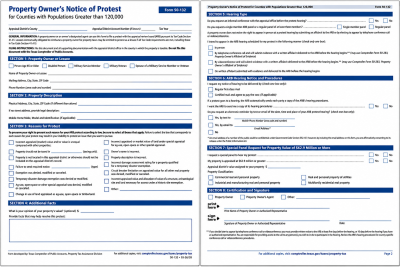
Texas property owners can use Form 50-132 to protest their property’s appraised value and certain other appraisal district decisions. The form is submitted to the appropriate county appraisal district for review by the Appraisal Review Board (ARB). Important Note: Texas provides different property tax protest forms based on county population. Homeowners in Hays, Comal, and Guadalupe counties generally use Form 50-132, while Caldwell County homeowners use Form 50-132-A, designed for counties with populations below 120,000. Both forms are available through the Texas Comptroller’s official property tax forms webpage. Always obtain the current official form before filing a protest.
If you believe your property has been overvalued, Texas law provides a process to challenge the appraisal. Property owners generally have until May 15 or 30 days after the appraisal district mails the notice of appraised value, whichever is later, to file a timely protest. You may challenge issues such as an incorrect market value, unequal appraisal, or certain errors affecting your property.
Useful evidence may include comparable sales, photographs, repair estimates, and documentation of property condition. For example, significant foundation problems, deferred maintenance, or structural damage may support an argument that the appraisal district overstated market value. The Texas Comptroller’s property tax protest guide explains the process and available options. You can also protest a valuation without hiring a property tax consultant.
Property Taxes on Texas Land and Acreage

This 38-acre property at 761 Allison Lane in San Marcos, Texas, illustrates the type of Central Texas acreage that may qualify for agricultural valuation, which can significantly affect property taxes.
Texas landowners may qualify for special agricultural or wildlife management appraisal, which can significantly affect Texas property taxes. However, what many people call an “ag exemption” is actually a special property valuation, not a traditional tax exemption. Qualifying agricultural land is generally appraised according to productivity value rather than market value.
The land must meet applicable use, history, and intensity requirements; simply owning several acres does not automatically qualify. Certain wildlife management activities may also qualify when statutory conditions are met. Furthermore, changing qualifying land to a nonagricultural use can trigger rollback taxes. For many properties receiving 1-d-1 agricultural appraisal, rollback taxes generally cover the previous three years of tax savings.
Anyone purchasing acreage should investigate its current agricultural appraisal status and the consequences of changing its use. The Texas Comptroller’s agricultural and wildlife appraisal guide is a useful resource.
Property Tax Considerations When Buying or Selling a Home
One mistake buyers sometimes make is assuming their future property taxes will match the seller’s current bill. The seller may have exemptions, a tax ceiling, or a capped appraised value that does not carry over in the same way. In addition, buying a home does not automatically mean its appraised value becomes the sales price. Texas appraisal districts determine values under applicable appraisal laws.
Buyers should investigate MUD taxes, PID assessments, and other special district obligations. Sellers should understand how tax prorations are handled at closing. Our complete Texas home buying guide explains other costs buyers should consider when preparing for a purchase. Understanding these expenses before entering a contract can help prevent financial surprises.
Frequently Asked Questions About Texas Property Taxes
When Are Texas Property Taxes Due?
Property tax bills are generally sent in the fall. Most property owners must pay by January 31 of the following year to avoid delinquency beginning February 1. However, different deadlines can apply in certain circumstances, including late-mailed bills.
Do I Have to Apply for My Homestead Exemption Every Year?
Generally, no. Once approved, a qualifying homestead exemption usually continues unless your eligibility changes or the appraisal district requires updated information.
Can I Have a Homestead Exemption on Two Homes?
Generally, no. A homeowner cannot claim the general residence homestead exemption on multiple properties as their principal residence at the same time.
Does Turning 65 Automatically Lower My Property Taxes?
Turning 65 may qualify you for additional exemptions and tax protections. However, you should verify that the appropriate exemption has been applied to your property.
Can I Protest My Property Taxes Every Year?
You can generally protest your property’s appraisal each year if you have grounds to do so. However, protesting appraised value is different from challenging tax rates adopted by local governments.
Do Texas Property Taxes Change When I Buy a Home?
They can. Your taxable value, exemptions, and applicable tax rates may differ from those of the previous owner. Therefore, obtain a property-specific estimate before purchasing.
Are Property Taxes Lower Outside City Limits?
Sometimes, but not always. Properties outside city limits generally do not pay that city’s property taxes. However, school districts and other special taxing entities can still affect the overall bill.
Where Can I Find My Property’s Tax Information?
Begin with the appraisal district for the county where your property is located. You can review appraised values, available exemptions, and taxing jurisdictions. The county tax office can provide information about actual bills and payments.
Your Local Central Texas Real Estate Expert
Understanding Texas property taxes is an important part of homeownership, whether you are buying your first home, purchasing acreage, or planning to sell. Across Hays, Comal, Caldwell, and Guadalupe counties, I have seen how property values, tax rates, exemptions, and special districts can influence real estate decisions. With more than 18 years of experience serving Central Texas, I believe buyers and sellers deserve accurate information before making major financial commitments.
If you are considering buying or selling in San Marcos, Kyle, Buda, New Braunfels, Wimberley, Canyon Lake, Lockhart, Seguin, or surrounding communities, our team can help you understand the local real estate market. Choosing a knowledgeable professional can make a difference. Our article on how to choose the right real estate agent explains what buyers and sellers should consider.
Thinking about buying or selling a home in Central Texas? I would welcome the opportunity to help. Contact the Walker Texas Team and let’s discuss your real estate goals.
This article is intended for general educational purposes and is not tax or legal advice. Property tax laws, exemptions, eligibility requirements, and rates may change. Consult the appropriate appraisal district, tax office, or qualified tax professional regarding your circumstances.
By James Walker Associated Broker & Team Lead Walker Texas Team | Keller Williams Realty San Marcos, Texas

Walker Texas Team at Keller Williams Realty KW ATX—trusted real estate experts serving San Marcos, TX and the Central Texas area.