
Choosing a real estate agent may be one of the most important decisions you make when buying or selling real estate. Yet, after nearly two decades in this business, I’ve found that many consumers spend surprisingly little time researching the person they trust to represent them.
I’ve watched buyers and sellers choose an agent primarily because that person was a friend, relative, neighbor, or simply someone they knew. I’ve also seen consumers hire agents who primarily work hundreds of miles from the community where the transaction is taking place.
Some people never checked whether their agent’s license was active or how long they had actually practiced real estate. Others may not have investigated the agent’s education, recent experience, or experience with that particular type of property.
That pattern is understandable because real estate is a relationship business. Working with someone you already know can feel comfortable. However, familiarity isn’t a substitute for competence, experience, ethics, and relevant local knowledge.
Your Agent May Be Advising You on One of Your Largest Financial Decisions
Whether you’re buying your first home, selling a longtime property, purchasing acreage, building new, investing, or acquiring commercial property, the stakes can be substantial. Your real estate agent may help you navigate a transaction involving hundreds of thousands—or even millions—of dollars.
If you’re preparing to buy, my Texas Home Buying Process | Complete Guide – Walker Texas Team explains the process through closing. If you’re preparing to sell, my Texas Home Selling Process: Complete Step-by-Step Guide – Walker Texas Team explains the seller’s side.
Your agent may help you understand contracts, negotiate terms, manage deadlines, evaluate property information, and coordinate inspections. They may also communicate with lenders, title companies, builders, attorneys, surveyors, and other professionals.
When problems arise before closing, your agent may become one of the professionals you depend on most for guidance. That’s why I believe consumers should approach choosing a real estate agent much like they would choose another important professional.
Don’t choose someone simply because you know them. Choose them because you’ve determined they’re qualified to represent you and your interests.
Don’t Just Ask Questions — Verify the Answers
One of my primary goals with this guide is to show you how to do that. TREC’s Consumer Guide recommends interviewing multiple brokers or sales agents and researching the professionals you’re considering.
The Texas Real Estate Commission, or TREC, also provides resources for verifying whether someone holds an active Texas real estate license. You can review other important information about the license holder as well.
Throughout this guide, I’ll explain what you can independently verify and what you should ask an agent directly. I’ll also identify situations where you may need to dig deeper.
We’ll examine licensing, education, disciplinary history, experience, transaction history, local knowledge, property specialization, contracts, communication, representation, conflicts, compensation, and other important considerations.
The objective isn’t simply to give you a list of questions. It’s to help you determine whether the answers are meaningful and, whenever possible, verify them yourself.
Written by James Walker, Broker Associate and Team Lead, Walker Texas Team | Keller Williams Realty
Real Estate Agent, REALTOR® and Broker Don’t Mean the Same Thing
The words real estate agent, REALTOR®, and broker are often used interchangeably, but they don’t mean the same thing.
A Texas real estate license is issued and regulated by The Texas Real Estate Commission (TREC). REALTOR®, on the other hand, identifies a member of the National Association of REALTORS®.
Members agree to follow the organization’s Code of Ethics in addition to the laws and regulations governing their real estate licenses.
A broker has met additional Texas licensing requirements beyond those required of a sales agent. Later in this guide, we’ll explain these differences in plain English, including what it means when someone uses the title broker associate.
Understanding the title is useful. However, a title alone doesn’t tell you whether someone is the right real estate agent for your transaction.
A Real Estate License Is the Starting Point, Not the Finish Line
Having an active license tells you that someone has met the requirements necessary to hold that license. It doesn’t tell you everything about the professional behind it.
Someone may have been licensed for many years but completed relatively few transactions. Another person may practice real estate occasionally while maintaining an entirely different full-time career.
An agent could have extensive experience selling suburban homes but little experience with acreage, farm and ranch, commercial property, or new construction. Likewise, someone successful 200 miles away may know little about the Central Texas community where you’re preparing to buy or sell.
That’s why choosing a real estate agent requires looking beyond the license itself.
Whose Interests Will Your Agent Put First?
This may be one of the most important questions in this entire guide.
TREC’s Consumer Guide explains that a broker or sales agent representing a client must put the client’s interests above everyone else’s. That includes the license holder’s own interests.
The principle sounds simple. In an actual transaction, however, significant financial incentives can surround whether a property successfully closes.
After nearly two decades in real estate, I believe consumers should understand who represents them and how that person is compensated. They should also understand other financial relationships and potential conflicts that may exist.
Later, we’ll examine the same brokerage representing both sides, including intermediary relationships. We’ll also discuss situations where an agent or someone connected to the agent is interested in purchasing a client’s property.
Finally, we’ll examine situations where a real estate agent may also arrange a buyer’s mortgage financing.
The point isn’t to assume that a potential conflict means someone is doing something wrong. Instead, recognize potential conflicts, understand the financial interests involved, and ask informed questions before making decisions.
Questions I Believe Every Buyer and Seller Should Ask
After nearly two decades in this business, some questions I believe consumers should ask are surprisingly straightforward:
Does this person actually know what they’re doing?
How active are they in real estate today?
Do they know the community where I’m buying or selling?
Have they handled this type of property before?
Do they understand the contracts and documents they’re asking me to sign?
Will they be available when I need them?
Can I independently verify their experience, licensing, education, and credentials?
And perhaps most importantly:
If protecting my interests could jeopardize the transaction and the agent’s commission, will that agent still put my interests first?
Those are the kinds of questions this guide is designed to help you answer. My goal isn’t to tell you which real estate agent to hire.
Instead, I want to give you the knowledge and tools to make that decision for yourself.

Choosing a real estate agent starts with asking questions, discussing expectations and understanding how the agent will represent your interests.
Real Estate Agent, REALTOR® and Broker — What’s the Difference?
One of the first things I think consumers should understand when choosing a real estate agent is what the different titles actually mean. During my years in real estate, I’ve found that many buyers and sellers use real estate agent, REALTOR®, and broker interchangeably.
I understand why. From a consumer’s perspective, these professionals may appear to do many of the same things. In Texas, however, the terms have different meanings.
Understanding those differences won’t tell you whom to hire. However, it provides a better starting point for evaluating someone’s licensing, education, experience, responsibilities, and professional obligations.
What Is a Texas Real Estate Sales Agent?
Texas licenses individuals as real estate sales agents and brokers through the Texas Real Estate Commission.
A Texas sales agent must complete 180 hours of qualifying real estate education. Applicants must also pass the required licensing examination and background-check process while meeting TREC’s other licensing requirements.
TREC initially issues the license as inactive. Before performing brokerage services, a sales agent must be sponsored by an active Texas broker.
This distinction matters because a sales agent isn’t operating completely independently. TREC explains that sales agents work with clients on behalf of their sponsoring broker.
The broker remains responsible for brokerage activities performed by sponsored agents.
What Is a REALTOR®?
A REALTOR® is not a separate type of Texas real estate license. REALTOR® identifies a real estate professional who is a member of the National Association of REALTORS®.
TREC specifically tells consumers that membership in the National Association of REALTORS® is voluntary. Therefore, not every Texas real estate license holder is a REALTOR®.
Members also subscribe to the Code of Ethics. We’ll examine those ethical obligations more closely later because consumers should understand what REALTOR® membership means.
It is more than a word on a business card or advertisement.
What Is a Texas Real Estate Broker?
A Texas real estate broker holds a higher-level Texas real estate license. Brokers can perform brokerage services independently, and they may sponsor sales agents.
TREC also holds brokers responsible for brokerage activities performed by the sales agents they sponsor.
The licensing requirements go beyond those for an initial sales-agent license. Current Texas broker requirements include considerably more education and qualifying real estate experience.
Effective January 1, 2026, Texas increased the experience requirements for broker applicants and made the six-hour Broker Responsibility Course mandatory for all broker applicants.
For consumers, that additional licensing level is worth understanding. However, I would never suggest choosing someone simply because the word broker appears after their name.
The same principle we’ll use throughout this guide still applies: look at the complete professional, not just the title.
What Is a Broker Associate?
This term can be particularly confusing. A broker associate, sometimes called an associated broker, is an individual who holds a Texas broker license.
Instead of operating independently, that broker chooses to associate with another licensed broker.
TREC explains that broker associates still hold broker licenses and are not sponsored in the same way sales agents are. They may choose that arrangement for access to a brokerage’s brand, tools, resources, opportunities, or other business reasons.
That’s an important distinction for consumers. Someone described as a broker associate has satisfied the requirements for a Texas broker license, even though they have chosen to associate with another licensed broker.
A Real-World Example: How My Own Licenses and Roles Fit Together
My own professional roles are a good example of why these titles can sometimes be confusing to consumers.
I hold a Texas real estate broker license and serve as the designated broker for Walker Texas Properties, Inc. You can verify that through the TREC License Holder Search.
A designated broker is the individual broker responsible for a licensed business entity and its brokerage activities.
At the same time, I am associated with Keller Williams Realty in Austin as a broker associate. Within Keller Williams, I lead the Walker Texas Team, which serves San Marcos and surrounding Central Texas communities.
I am also a REALTOR®, a member of the National Association of REALTORS®. That distinction is separate from my Texas broker license.
My broker license is issued and regulated by the State of Texas through The Texas Real Estate Commission. REALTOR® identifies my membership in The National Association of REALTORS® and my commitment to its Code of Ethics.
Depending on where you see my name, you may encounter several different titles or business names. These include Broker, Broker Associate, Team Lead, Walker Texas Properties, Inc., Walker Texas Team, Keller Williams Realty, or KW ATX.
Those terms describe different licenses, business entities, brokerage relationships, or roles. They don’t all mean the same thing.
This example also shows why I encourage consumers to look beyond the title on an agent’s business card. Ask what the title means and which brokerage the person is associated with.
You should also understand who is responsible for the brokerage activity. Then independently verify the information through the TREC License Holder Search.
The Title Is Only the Beginning
Knowing whether someone is a sales agent, REALTOR®, broker, or broker associate provides useful information. However, it doesn’t answer the larger question:
Is this person qualified for my transaction?
I’ve known consumers who assumed that having a real estate license automatically meant someone had extensive experience. That’s not necessarily true.
Likewise, REALTOR® membership doesn’t tell you how many transactions someone has completed. A broker license indicates higher licensing requirements, but the title alone doesn’t establish expertise.
Someone may have little experience in the community where you’re buying or selling or with a property type such as land, new construction, or commercial real estate.
That’s why I encourage consumers to look beyond titles. The next step is something surprisingly few people do before hiring a real estate agent.
Verify the person’s license and professional history yourself through the TREC License Holder Search. TREC gives Texas consumers tools to begin doing exactly that.
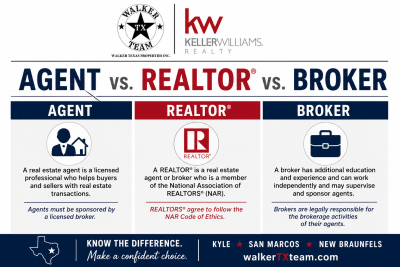
Agent, REALTOR® and broker are not interchangeable terms. Understanding the differences can help consumers make a more informed choice when hiring real estate representation.
Verify a Texas Real Estate Agent Before You Hire Them
When choosing a real estate agent, one of the easiest and most important things you can do is verify the person’s license yourself. You don’t have to rely solely on an agent’s website, business card, social media profile, or what someone tells you.
The Texas Real Estate Commission maintains an online TREC License Holder Search with information about Texas real estate license holders. TREC itself recommends using this resource when evaluating a broker or sales agent.
Before hiring someone, I recommend looking them up through the TREC License Holder Search. It only takes a few minutes, and you may learn considerably more than you expected.
Start by Checking Whether the License Is Active
The first thing I would check is simple: Does this person currently have an active Texas real estate license?
A TREC license record identifies whether the individual is a sales agent or broker. It also shows the current license status and expiration date.
For a sales agent, the record can identify the sponsoring broker as well.
Don’t assume someone’s license is active because they have been in real estate for years, maintain a real estate website, have an old business card, or previously helped someone you know.
I’ve encountered situations during my career where consumers were dealing with someone whose license was no longer current. That’s one reason I believe verification should happen before you establish a professional relationship—not after a problem occurs.
Look at More Than the Expiration Date
While reviewing the record, pay attention to the type of license and, for a sales agent, the sponsoring broker. That information can answer several basic questions:
Who is this person currently associated with?
Are they a sales agent or broker?
Is the license active?
When does it expire?
Who sponsors the sales agent?
These are basic facts that shouldn’t be difficult to verify.
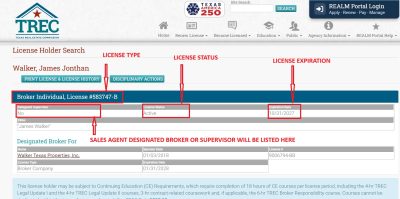
Texas consumers can use the TREC License Holder Search to verify an agent’s license type, current status, expiration date and supervising broker information.
Review the Agent’s Education History
This is one of the TREC tools I wish more consumers knew about. A license holder’s record can display education connected to the license, including course names, dates, providers, subjects, and hours.
Current TREC records can show coursework involving contracts, legal updates, broker responsibility, negotiation, representation, septic systems, farm and ranch, and other topics.
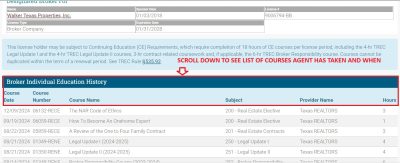
TREC license records allow consumers to review an agent or broker’s education history, including completed courses, dates, subjects and providers.
Don’t look only at the number of hours. Look at what the agent has chosen to learn.
If you’re buying acreage outside San Marcos, education involving septic systems, wells, surveys, easements, farm and ranch issues, or land contracts may be relevant. Someone purchasing a residential property may want to see continued contract and legal education.
Education doesn’t prove competence by itself. However, it provides another useful piece of information when you’re comparing real estate professionals.
Minimum Education and Continued Learning Aren’t the Same Thing
Every license holder must satisfy the education requirements applicable to their license. That doesn’t mean every real estate professional approaches continued education in the same way.
Some people do what is necessary to maintain their license. Others continually pursue additional education in contracts, legal issues, negotiation, property types, market changes, and areas in which they specialize.
Over the years, I’ve become a strong believer in continued education. Real estate laws, contracts, regulations, technology, financing, and industry practices change.
An agent shouldn’t assume that what they learned when they first became licensed is enough for the rest of their career.
For consumers, the lesson is simple:
Don’t just ask, “Are you licensed?” Ask, “What have you continued to learn since you became licensed?” Then verify what you can.
Check for Disciplinary Actions
This may be one of the most important features of the TREC search that many consumers don’t know exists. TREC states that its License Holder Search provides information about disciplinary actions involving a license holder.
Its consumer guidance also directs consumers to use the lookup when researching someone they may hire.
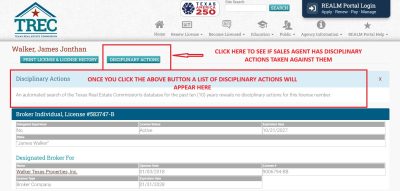
TREC allows consumers to check whether a Texas real estate license holder has disciplinary actions recorded during the searchable period.
I believe consumers should check this before hiring a real estate agent or broker.
Finding a disciplinary action doesn’t necessarily tell you everything about the circumstances. If something appears, read the available information carefully and understand what happened rather than immediately drawing conclusions from a heading.
You also shouldn’t be afraid to ask the agent about what you found.
A major theme of this guide is don’t just ask—verify. Disciplinary history is an excellent example of information you don’t have to take someone’s word for.
What TREC Cannot Tell You
TREC is an extremely useful starting point, but it doesn’t answer every question you should have when choosing a real estate agent.
An active license doesn’t tell you whether someone has completed five transactions or five hundred. The license record also doesn’t necessarily tell you whether the agent has meaningful experience in San Marcos, Kyle, or New Braunfels.
It doesn’t establish whether someone understands your neighborhood, has handled acreage, knows new construction, understands commercial transactions, or has sold your type of property.
That’s why I wouldn’t stop with a license search.
Think of TREC as Step One of your due diligence—not the entire investigation.
The next step is determining how much real-world experience the agent actually has. Equally important, you need to determine whether that experience is relevant to your particular transaction.
Experience Matters — But Make Sure It’s the Right Experience
Experience is one of the first things I would consider when choosing a real estate agent. However, I think consumers need to look deeper than simply asking, “How long have you been in real estate?”
Years licensed and years of meaningful experience aren’t necessarily the same thing. Someone can hold a real estate license for many years while completing relatively few transactions.
Another agent may have been licensed for a shorter period but work full time and handle transactions consistently. That’s why I believe a better question is:
“Tell me about the real estate work you’ve actually done.”
Ask About Actual Transaction Experience
I wish there were one reliable public database where a Texas consumer could enter an agent’s name and see every transaction that person has completed throughout their career.
There isn’t.
Consumers may find sales information on real estate portals, agent websites, brokerage pages, reviews, and other online sources. However, I would be careful about treating any one source as a complete lifetime transaction history.
Instead, ask the agent directly. How many transactions have you handled? How many have you completed recently?
Were you representing buyers, sellers, or both? What types of properties were involved? How much of that experience occurred in the market where I need help?
An experienced professional should be comfortable discussing their background. Don’t be impressed by a large number until you understand what that number represents.
Recent Experience Matters Too
Real estate experience isn’t something I would measure only by lifetime transactions. Markets, contracts, laws, and regulations change.
Financing practices evolve as well. Technology continues to change how properties are marketed and transactions are managed.
An agent who was extremely active 15 years ago but now completes occasional transactions may have limited exposure to today’s market. That differs from someone who is actively negotiating contracts and solving transaction problems every week.
That’s why I would ask:
“How active are you in real estate today?”
The TREC Licensed Holder Search we discussed in the previous section can help establish licensing and education information. However, TREC doesn’t provide a consumer-facing lifetime sales-production total on the individual license records we’ve reviewed.
Evaluating actual transaction experience requires additional investigation.
The Right Experience Matters More Than the Biggest Number
Suppose one agent tells you they’ve closed 500 residential transactions. That sounds impressive, but what if you’re purchasing 75 acres outside San Marcos?
That property might involve a well, septic system, agricultural valuation, easements, fencing, mineral questions, and no municipal utilities. The number 500 doesn’t tell you whether that person understands those issues.
That same principle applies to commercial buildings, farm and ranch property, investment property, new construction, waterfront property, and other specialized real estate.
The 2026 Code of Ethics & Standards of Practice addresses professional competency. REALTORS® are expected to provide services consistent with the competence reasonably expected within the particular real estate discipline in which they’re working.
A REALTOR® shouldn’t undertake specialized professional services outside their field of competence unless appropriate assistance is obtained or the circumstances are disclosed to the client.
Ask for Experience That Resembles Your Transaction
If you’re interviewing someone to sell your home in San Marcos, ask about their experience representing sellers and marketing homes there. Buying in Kyle? Ask about Kyle.
Considering New Braunfels? Ask what experience they have there.
For land, acreage, farm and ranch, commercial property, or new construction, go another step. Ask about transactions involving those property types.
I wouldn’t consider these questions confrontational. You’re interviewing someone for an important professional job, and a good real estate agent should understand why you want to know.
Later in this guide, we’ll look much deeper at property specialization. For now, remember this:
The question isn’t simply, “How experienced is this agent?”
The better question is, “How much of this agent’s experience is relevant to what I am about to do?”
What About a New Real Estate Agent?
Everyone has to begin somewhere. Being newly licensed doesn’t automatically mean someone will provide poor representation.
What I would want to know is who is helping that new agent. Does the agent have an experienced broker, mentor, team leader, or transaction professional available when questions arise?
Are contracts being reviewed? Is someone helping the agent recognize problems they may not yet have encountered?
TREC emphasizes that sales agents work on behalf of their sponsoring broker. Brokers are responsible for brokerage activities performed by the sales agents they sponsor.
That makes broker support a legitimate question for a consumer to ask.
A new agent working closely with an experienced professional may provide excellent service. I would be more concerned about a new agent left largely alone to learn complicated transactions through trial and error.
The client’s money and property are at stake.
Experience Should Be Demonstrated, Not Just Advertised
When choosing a real estate agent, don’t be afraid to ask for specifics. You aren’t looking for someone who can simply tell you they’ve been in the business “a long time” or that they’re a “top agent.”
You’re trying to determine whether their actual experience matches your market, property, and transaction.
That distinction becomes even more important when we talk about local knowledge. An agent can have decades of experience somewhere else and still know very little about the community where you’re preparing to buy or sell.
That brings us directly to another important question: Does the agent actually know your local market?

Luxury homes on acreage can involve wells, septic systems, land and other considerations that require relevant real estate experience.
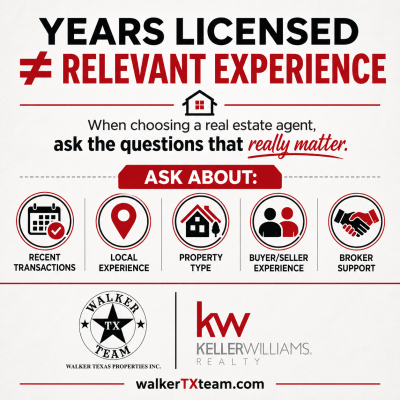
Years licensed do not always equal relevant experience. Ask about recent transactions, local knowledge, property type, buyer or seller experience and broker support.
Does the Agent Actually Know Your Local Market?
An agent can have years of experience and still know very little about the community where you’re buying or selling.
This is one of the biggest issues I see when consumers are choosing a real estate agent. Someone may be an excellent agent in Austin, San Antonio, Houston, Dallas, or another market.
That doesn’t automatically make that person the right choice for a transaction in San Marcos, Kyle, New Braunfels, or another Central Texas community.
Real estate is local. In my experience, sometimes very local.
Local Knowledge Is More Than Knowing Home Prices
When I talk about local knowledge, I don’t simply mean knowing the median sales price or pulling comparable sales from the MLS.
An agent who regularly works in a community may understand differences that aren’t obvious from looking at listings online.
In and around San Marcos, for example, properties can involve floodplain considerations, older neighborhoods, historic properties, student-oriented housing, and newer master-planned developments. Other properties may involve acreage, wells, septic systems, agricultural land, waterfront, or locations outside city limits.
Drive only a few miles and the issues affecting a transaction can change considerably.
That’s why I believe consumers should ask an agent to explain their actual experience in the community, not simply whether they’re willing to work there.
For a deeper look at the San Marcos community, my Living in San Marcos TX: What’s It Like? guide covers neighborhoods, lifestyle, growth, transportation, the river, rural areas, and other characteristics that make San Marcos unique.
Living 100 or 200 Miles Away Doesn’t Automatically Disqualify an Agent
I want to be fair about this because distance alone doesn’t determine whether someone is competent.
An agent who lives outside a community may have substantial transaction experience there. Likewise, an agent who lives nearby may have very little experience.
The problem arises when an agent takes on a transaction in an area they don’t really know, particularly when the primary reason is that the buyer or seller happens to be a friend, relative, or referral.
I’ve seen agents travel a considerable distance to represent someone simply because they didn’t want to give up the potential commission.
That’s where I believe the consumer needs to ask an important question:
“Is this person the best professional for my transaction—or simply the person I already know?”
A Referral Can Sometimes Serve the Client Better
There’s nothing wrong with an agent admitting that another professional may be better suited for a particular market. In fact, I respect it.
If a client wanted me to handle a transaction in a Texas market where I had little knowledge or experience, I would seriously consider whether that client would be better served by someone who works there regularly.
Real estate professionals can refer clients to qualified agents in other markets. The referring broker may potentially receive a referral fee when properly handled.
More importantly, the client gains representation from someone familiar with the market where the transaction is taking place.
For REALTORS®, this concept also connects to Article 11 of the Code of Ethics. Article 11 addresses providing services within areas of competence or obtaining appropriate assistance when working outside them.
Consumers can review this professional standard in the 2026 Code of Ethics & Standards of Practice.
Ask the Agent to Demonstrate Local Knowledge
Don’t settle for:
“Yes, I work in San Marcos.”
Ask follow-up questions. How many transactions have you handled here? When was your most recent one?
Have you represented buyers, sellers, or both? What neighborhoods and areas have you worked in?
What issues do you commonly encounter here?
Then listen carefully to the answers.
Someone with genuine local experience should usually be able to have a meaningful conversation about the community. They shouldn’t simply repeat information anyone could find through a Google search.
San Marcos, for example, isn’t simply a smaller version of Austin or San Antonio. It has its own market, geography, history, university influence, river, development patterns, neighborhoods, rural surroundings, and property considerations.
Local Knowledge Can Be Extremely Property-Specific
Even within one market, an agent may need different knowledge depending on the property.
A subdivision home connected to city water and sewer presents different questions from ten acres outside the city limits with a well and septic system. Riverfront property presents different considerations from a downtown condominium.
Likewise, a commercial building requires a different skill set from a single-family residence.
This is where local knowledge and property-specific experience begin to overlap.
In the San Marcos area, I wouldn’t want a buyer looking at rural acreage to assume that purchasing land is simply purchasing a house with more space around it. Access, utilities, water, septic, surveys, easements, restrictions, floodplain considerations, agricultural issues, and future land use can all become important.
We’ll address those differences much more deeply later in this guide.
Look for Evidence of a Real Connection to the Community
Transaction history is important, but I think there’s another kind of local knowledge worth considering.
Does the agent actually know the community? Do they understand how it has changed?
Do they know the roads, neighborhoods, local institutions, and surrounding areas? Are they involved enough to understand issues residents are talking about?
For me, San Marcos isn’t simply a market where I sell real estate. I’ve lived in the area for decades, built my career here, and raised my family here.
I’ve also spent years supporting and participating in local organizations and community events.
That doesn’t automatically make me the right agent for every transaction. However, it gives me a perspective that can’t be created by downloading market statistics the morning before meeting a client.
That’s the distinction I want consumers to understand.
Local Doesn’t Mean the Agent Has to Know Everything
No competent professional knows everything about every property or every issue.
A good local agent should also know when additional expertise is needed. That may mean recommending that a client consult an attorney, surveyor, engineer, inspector, lender, title professional, septic professional, well specialist, municipality, county office, or another appropriate expert.
To me, saying “I don’t know, but I know how we can find out” is far more valuable than pretending to know an answer.
Local expertise isn’t about having every answer memorized. It’s about having enough experience with the area to recognize which questions need to be asked.
Don’t Confuse a Large Service Area With Local Expertise
Real estate marketing makes it easy for an agent to claim an enormous territory.
A website can list dozens—or even hundreds—of cities. An online profile can make someone appear local almost anywhere.
That doesn’t mean the agent has meaningful experience in every place listed.
When choosing a real estate agent, ask for evidence that connects the person to your particular market. Recent transactions, years working in the area, knowledge of specific neighborhoods, familiarity with local property issues, community involvement, and relevant client experiences can all help paint a more complete picture.
The question isn’t:
“Will you come here?”
The better question is:
“What do you know about here?”

James Walker marches with his son in a downtown San Marcos veteran’s parade while wearing his San Marcos Lions Club vest.
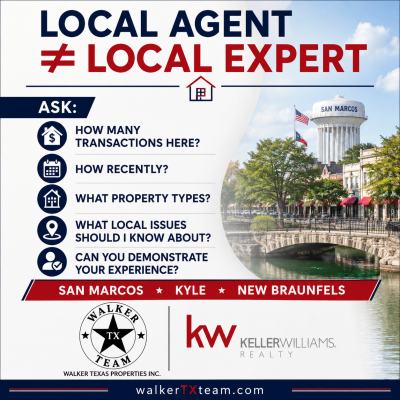
Working locally does not automatically make an agent a local expert. Ask about recent transactions, property types and firsthand market knowledge.
Hiring a Friend or Family Member — Why Qualifications Still Matter
Real estate is a relationship business, so it’s completely understandable that many buyers and sellers first think about someone they already know when choosing a real estate agent. Maybe your cousin has a real estate license. Your neighbor recently became an agent. A longtime friend works for a brokerage. Perhaps a relative who lives several hours away offers to represent you because they don’t want you to “give the commission to someone else.”
There’s nothing inherently wrong with hiring a friend or family member. That person may be an excellent real estate professional and exactly the right choice. The problem is hiring someone because of the relationship rather than because of their qualifications.
Your Real Estate Transaction Is Too Important to Become a Favor
Buying or selling real estate may involve hundreds of thousands—or even millions—of dollars. You’re dealing with contracts, deadlines, inspections, negotiations, financing, title issues, disclosures, and decisions that can have financial consequences long after closing.
Buyers who want to understand the transaction from beginning to closing can also read my Texas Home Buying Process – Complete Guide.
I wouldn’t choose an attorney, CPA, surgeon, or financial professional solely because that person was my friend or relative. I think consumers should approach real estate representation with the same mindset. Ask yourself:
“If I didn’t know this person personally, would I still hire them based on their experience and qualifications?”
That’s a powerful question. If the answer is yes, great. However, if the answer is no—or you’re not sure—the personal relationship shouldn’t prevent you from interviewing other professionals.
Friendship Doesn’t Replace Relevant Experience
The same standards we’ve discussed throughout this guide should apply to someone you know personally. Verify their license and review their education and disciplinary history. Ask about recent transactions, local knowledge, and experience with your type of property.
A friend who primarily sells suburban homes in another part of Texas may not be the right person to help you purchase acreage outside San Marcos. Likewise, a relative who occasionally handles residential transactions may lack relevant experience with commercial buildings, farm and ranch property, waterfront homes, investment properties, or complicated land transactions.
Being someone you trust personally is valuable. Personal trust and professional competence, however, are two different things.
Be Especially Careful With an Out-of-Area Friend or Relative
This is something I’ve encountered repeatedly during my career. A buyer decides to purchase in San Marcos, Kyle, New Braunfels, or another Central Texas community. Then a friend or relative who holds a real estate license somewhere else in Texas wants to handle the transaction.
Sometimes that agent may live 100 or even 200 miles away. As we discussed in the previous section, distance alone isn’t the problem. An agent can live outside a community and still have meaningful experience there.
My concern is when the agent has little or no actual experience in that market. It becomes more concerning when they accept the transaction primarily because of the personal relationship or potential commission. At that point, ask yourself whether loyalty to the agent could unintentionally work against your own interests.
A Good Friend Should Want You to Have the Right Representation
An agent who lacks the appropriate local or property-specific experience has another option: help connect the friend or family member with a qualified professional. Referral arrangements between real estate brokers are common. When properly structured, a referring broker may receive compensation while the consumer works with someone better positioned to handle the transaction.
That can be a better outcome than trying to navigate an unfamiliar market simply to retain the entire commission. To me, recognizing when someone else is better equipped to serve a client isn’t a weakness. It’s professionalism.
For REALTORS®, this also connects to the professional competency principles contained in Article 11 of the 2026 Code of Ethics & Standards of Practice.
Personal Relationships Can Make Difficult Conversations Harder
There’s another issue that doesn’t receive enough attention. Real estate transactions sometimes require uncomfortable conversations. A listing agent may need to tell a seller that the price they want isn’t supported by the market. A buyer’s agent may need to explain why walking away from a property should be considered.
Negotiations can become stressful, while inspection findings can create disagreements. Sometimes an agent needs to tell a client something the client simply doesn’t want to hear. Those conversations can become more complicated when the agent is a close friend or family member. The client may hesitate to challenge the agent, while the agent may have difficulty separating the professional relationship from the personal one.
That doesn’t mean friends and relatives shouldn’t work together. It means both parties should recognize that real estate representation is a professional relationship first.
Don’t Hire Someone Because You Feel Obligated
I’ve seen consumers worry that a friend or relative will be offended if they choose another agent. I don’t think anyone should make one of the largest financial decisions of their life based on fear of hurting someone’s feelings.
You have every right to interview multiple professionals. Ask each person the same questions and compare their qualifications. Consider experience, local knowledge, communication, availability, education, property-specific expertise, and how they intend to represent your interests. Then choose the person you believe is best qualified for the job.
If your friend or relative is that person, you’ve made the decision for the right reason. If someone else is better qualified, you shouldn’t feel guilty about choosing them.
Use the Same Checklist for Everyone
One of the goals of this guide is to give consumers an objective way to evaluate real estate professionals. That becomes especially useful when personal relationships are involved. Instead of asking only:
“Do I like and trust this person?”
Ask a few more questions:
Are they properly licensed?
Are they actively working in real estate?
Do they know this community?
Have they handled this type of property?
Do they understand the contracts involved?
Do they have the time and resources to represent me properly?
Can they demonstrate relevant experience?
Personal trust still matters. It simply shouldn’t be the only qualification. Ultimately, choosing a real estate agent should be a business decision. That professional may be responsible for helping you protect an extremely valuable asset.
Friendship and family relationships can absolutely coexist with excellent representation. Just make sure the qualifications come first.
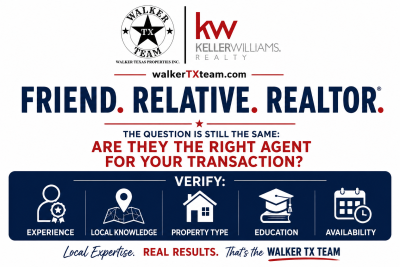
Friendship or family connection should not replace due diligence. Verify experience, local knowledge, property expertise, education and availability before hiring an agent.
Full-Time vs. Part-Time Real Estate Agents
One question I believe consumers should ask when choosing a real estate agent is surprisingly simple: “Is real estate your full-time career?”
Texas real estate licensing doesn’t require an agent to work a minimum number of hours or complete a minimum number of transactions each year. As a result, two people can both hold active Texas real estate licenses while having very different levels of day-to-day involvement in the business.
One may spend every working day dealing with clients, contracts, negotiations, inspections, lenders, title companies, and appraisals. Another may have a completely different full-time career and handle only an occasional real estate transaction.
Both can hold active licenses. What matters to you as a consumer is understanding what that difference could mean for your representation.
Part-Time Doesn’t Automatically Mean Unqualified
I don’t believe it’s fair to assume every part-time real estate agent is unqualified. Some part-time agents are experienced, knowledgeable, and extremely conscientious. They may intentionally limit the number of clients they accept so they have enough time to serve them properly.
Likewise, being a full-time real estate agent doesn’t automatically make someone more qualified. What matters is how actively the agent practices real estate and whether they have the time and availability to properly represent you.
That’s why I would look beyond the labels “full-time” and “part-time.”
Real Estate Doesn’t Operate on a Convenient Schedule
A real estate transaction doesn’t necessarily wait until an agent gets off work from another job. A new listing can hit the market Tuesday morning, while an inspection might uncover a serious problem later that day. Meanwhile, a lender may need information, an offer could arrive, or a contract deadline may be approaching.
If an agent has another job, I would want to understand how situations like these are handled. Ask:
“If you’re working another job when something important happens in my transaction, how will you handle it?”
The issue isn’t simply whether an agent has another job. The issue is whether that job could interfere with the representation you need.
Ask What Full-Time or Part-Time Means in Practice
Rather than stopping with “Are you full-time?”, ask questions that tell you how actively the agent is working in real estate today. Find out how many transactions they’ve completed during the past 12 months and how many clients they’re currently representing.
Ask how quickly they normally respond during the workday. You can also find out how they handle showings, inspections, negotiations, and other situations that may require attention during normal business hours.
If the agent has another occupation, ask how much of the working week is devoted to real estate and how flexible the other job is when a client needs attention.
Those answers give you a much better picture than the words “full-time” or “part-time” alone.
Full-Time or Part-Time: Ask the Questions That Matter
I wouldn’t hire an agent solely because they work in real estate full-time, and I wouldn’t automatically reject someone because they work part-time. Instead, I would determine whether the agent is actively practicing real estate and has the experience, availability, and time necessary for my transaction.
If real estate isn’t the agent’s full-time career, understand how another job could affect their ability to respond when you need them. If the agent is full-time, don’t assume the label alone proves they’re experienced or qualified.
Ask enough questions to understand what full-time or part-time practice could actually mean for you as a client.

James Walker works on client files after normal business hours, illustrating the availability and commitment often required in full-time real estate.
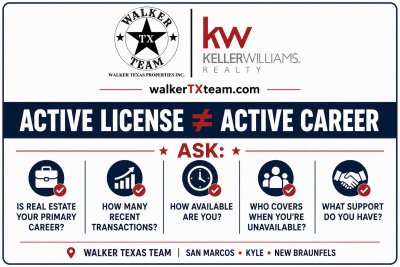
An active license does not always mean an active career. Ask about recent transactions, availability, coverage and professional support.
Education, Training and Understanding the Contracts
A real estate license tells you that someone has met the State of Texas requirements to become licensed. It doesn’t tell you everything about that person’s professional knowledge.
We’ve already discussed how consumers can use the Texas Real Estate Commission’s public records to review an agent’s license status and education history, so I won’t repeat those instructions here. Instead, I want to focus on a different question:
What has the agent done with that education?
When choosing a real estate agent, I believe consumers should look beyond whether someone passed the licensing exam. Ask whether that person has continued developing the knowledge needed to competently handle the type of transaction you’re considering.
Getting Licensed Is the Beginning of the Education
Texas currently requires applicants seeking a real estate sales agent license through TREC to complete 180 classroom hours of qualifying education. Those courses include Principles of Real Estate I and II, Law of Agency, Law of Contracts, Promulgated Contract Forms, and Real Estate Finance.
That’s an important educational foundation, but completing those courses doesn’t make someone an expert in every type of real estate transaction they may encounter.
An agent may eventually work with estates, divorce, trusts, investments, new construction, acreage, septic systems, wells, easements, surveys, floodplains, condominiums, and homeowners’ associations. Commercial, waterfront, and farm and ranch properties can introduce still more considerations.
No pre-licensing curriculum can provide practical experience with every situation. That’s why I consider getting a license the beginning of a real estate professional’s education—not the end of it.
Required Education and Professional Development Aren’t the Same Thing
Texas requires continuing education for many active license holders, but I think consumers should distinguish between meeting a licensing requirement and deliberately building professional expertise.
An agent may choose additional education in contracts, negotiations, land, new construction, commercial real estate, or another specialty. Professional designations, certifications, industry training, and studying changes to forms can also build knowledge beyond the minimum required for license renewal.
The question I’d ask isn’t simply:
“Did you complete your required continuing education?”
I’d ask:
“Have you taken any additional courses or training related to the type of property or transaction I’m hiring you to handle?”
That question tells you much more about how seriously someone approaches professional development.
Your Agent Should Understand the Documents You’re Being Asked to Sign
This is where education becomes very practical. Texas real estate transactions can involve numerous contracts, addenda, notices, and disclosures, with the exact documents depending on the transaction.
Over the years, I’ve encountered agents who didn’t have the level of understanding of the forms that I believe consumers assume a real estate professional should have. That concerns me because clients routinely look to their agent and ask:
“What does this mean?”
A real estate agent isn’t your attorney and shouldn’t provide legal advice they’re not authorized to give. However, a competent professional should understand the forms they routinely use, know how those forms function, and recognize when a question requires an attorney or another qualified professional.
There’s an important difference between recognizing your professional boundaries and simply not understanding the paperwork.
Ask Contract Questions During the Interview
You don’t need to give an agent a surprise examination. A normal conversation can tell you a great deal.
Ask a buyer’s agent how they explain the buyer representation agreement. If you’re interviewing a listing agent, ask what documents you’ll likely sign when listing your property. You can also ask how the agent handles contract deadlines, amendments, and other documents that may arise during a transaction.
Property type matters here too. If you’re buying land, ask what additional forms or issues may become relevant. For new construction, ask whether the builder uses its own contract and how the agent approaches transactions involving builder documents.
You’re not expected to know all the answers yourself. You’re listening to determine whether the person you’re considering can clearly explain the process and recognize the limits of their expertise.
Good Agents Know When to Get Help
One characteristic I value in any professional is being honest about the limits of their knowledge. Knowing when to involve someone with the appropriate expertise. Real estate intersects with law, taxes, lending, surveying, engineering, insurance, environmental matters, construction, and many other specialized fields.
A real estate license doesn’t make someone an attorney, CPA, engineer, surveyor, inspector, or lender. When something goes beyond my expertise, I believe my responsibility is to recognize that and help the client identify the appropriate professional or source of information.
Sometimes the answer:
“That’s outside my expertise, and we need to get the right professional involved.”
demonstrates far more competence than confidently guessing.
Look at What the Agent Chooses to Learn
As we discussed earlier, TREC’s public license records can provide information about an agent’s reported education history. Instead of simply checking whether courses are listed, look at what the agent has chosen to study.
You may find education involving contracts, legal updates, septic systems, farm and ranch transactions, title issues, financing, negotiations, property taxes, ethics, or other subjects. That history won’t tell you everything about someone’s competence, but it can provide another piece of evidence about the professional you’re considering.
I also look for a relationship between education and practice. Someone who regularly represents land buyers should continue learning about issues affecting land transactions. An agent concentrating on residential listings should stay current on contracts, disclosures, pricing, negotiations, and issues sellers routinely encounter.
New construction, commercial, waterfront, investment, luxury, and farm and ranch properties can each require additional knowledge. No agent needs to specialize in everything.
In fact, I’m more comfortable with someone who understands both what they know and what they don’t know than someone who claims expertise in virtually every area of real estate.
Education and Experience Should Work Together
I don’t believe there’s one qualification that determines whether someone is a good real estate agent. Twenty years of experience doesn’t excuse a professional from staying current, while dozens of courses and designations can’t reproduce the judgment developed through actual transactions.
The strongest professionals combine education with experience. Education builds knowledge, experience develops judgment, and continuing professional development helps keep that knowledge current.
When choosing a real estate agent, I would look for evidence of relevant education, practical experience, and a commitment to ongoing professional development.
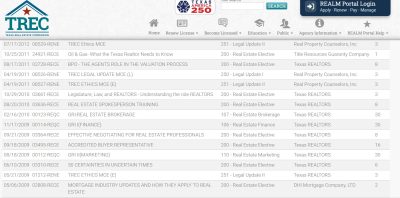
James Walker’s early coursework included brokerage, finance, marketing, buyer representation, negotiation, ethics and real estate law.

A real estate license is the starting point. Consider contract knowledge, continuing education, specialized training, experience and professional judgment when choosing an agent.
REALTOR® Ethics — What the Code of Ethics Actually Means
Earlier in this guide, I explained that real estate agent and REALTOR® aren’t interchangeable terms. I won’t repeat that distinction here. Instead, I want to explain why the REALTOR® Code of Ethics should matter when you’re choosing a real estate agent.
A Code of Ethics isn’t valuable simply because it exists. What matters is whether the professional understands those standards and applies them when money, negotiations, difficult decisions, and commissions are on the line.
I’ve taken ethics courses throughout my career, and years of working in real estate have reinforced something I believe strongly: consumers should pay attention to how an agent approaches ethical decisions, not simply whether REALTOR® appears after the person’s name.
Your Interests Should Come Before the Agent’s Commission
This principle is fundamental. Article 1 of the National Association of REALTORS® Code of Ethics requires REALTORS® to protect and promote their clients’ interests while treating all parties honestly.
Texas imposes important duties as well. TREC rules state that a license holder acting as an agent is a fiduciary and must make the client’s interests the license holder’s primary duty. Personal interests should not be placed above those of the client.
Those standards should guide an agent’s decisions throughout the transaction. They matter most when doing what’s right for the client means more work for the agent or could cause the deal to fall apart.
Sometimes Protecting a Client Means Risking the Deal
I feel strongly about this because I’ve seen situations where an agent becomes too focused on getting a transaction to closing. When that happens, the client’s interests can become secondary.
Real estate commissions are generally contingent on transactions closing, which creates an obvious financial incentive to get a deal across the finish line. However, the agent’s need to get paid should never become the client’s reason to proceed.
If I learn something that I’m required to communicate to my client and it could affect their decision, my concern shouldn’t be:
“Will telling them kill my deal?”
My concern should be:
“Does my client need this information to make an informed decision?”
That distinction matters. Protecting a client’s interests should come before protecting a commission.
Disclosure Isn’t Optional Because the Information Is Inconvenient
Article 2 of the NAR Code of Ethics requires REALTORS® to avoid exaggeration, misrepresentation, or concealment of pertinent facts relating to a property or transaction. At the same time, that obligation doesn’t turn a REALTOR® into an inspector, engineer, attorney, or other technical expert.
An agent isn’t expected to know everything hidden behind the walls of a house. However, knowing important information and being reluctant to communicate it because it could complicate the transaction are two very different situations.
Over the years, I’ve seen circumstances where information was known, but someone appeared hesitant to bring it forward because the deal might fall apart. That’s exactly when professional obligations matter most.
Consumers can read these standards directly in the 2026 Code of Ethics & Standards of Practice.
An Ethical Agent Sometimes Has to Tell You What You Don’t Want to Hear
Protecting a client’s interests doesn’t always mean agreeing with the client. A seller may want to hear that their home is worth substantially more than the market supports, while a buyer may desperately want a property even after serious concerns have surfaced.
In those situations, I believe my responsibility is to provide the best information I can, explain the risks within my expertise, and help my client make an informed decision. Sometimes that conversation isn’t comfortable.
I’d rather risk losing a listing, losing a sale, or watching a transaction terminate than withhold important information simply because I wanted the commission.
Sellers who want to better understand the decisions, disclosures, negotiations, and other steps involved in selling can read my Texas Home Selling Process: Complete Step-by-Step Guide.
Ethics Is More Than Avoiding an Obvious Violation
I think consumers sometimes imagine unethical conduct as something dramatic, such as fraud, stealing money, or deliberately falsifying documents. Ethical responsibility is much broader than that.
It can involve communicating important information promptly, being truthful about what you know and don’t know, maintaining confidentiality when required, presenting information accurately, and putting the client’s interests ahead of your own financial interests.
TREC rules also require license holders to act with integrity and avoid misrepresentation through acts or omissions. That last part is important because sometimes the problem isn’t what someone says. It’s what they choose not to say.
Ask Questions That Reveal How an Agent Thinks
You probably won’t learn much by asking:
“Are you ethical?”
Everyone is going to say yes. Instead, ask questions that require the agent to explain how they would approach a difficult situation.
A buyer might ask what the agent would do after discovering information that could make the buyer reconsider purchasing a property. A seller could ask how the agent would handle information that may need to be disclosed but could make the property harder to sell.
Another question I particularly like is:
“What would you do if the best advice for me meant you didn’t get paid?”
Listen carefully to the answer. You’re looking for someone who views their responsibility as representing your interests—not simply getting another transaction closed.
The Standard Should Be the Same When Nobody Is Watching
After many years in this business, this is how I think about professional ethics: it’s easy to talk about putting clients first when doing so costs you nothing. The real test comes when protecting the client means more work, a difficult conversation, a delayed closing, a smaller commission, or no commission at all.
That’s when the words “client first” actually mean something.
When choosing a real estate agent, I wouldn’t just ask whether someone has the experience to complete the transaction. I’d also consider whether I trust that person to protect my interests when doing so becomes inconvenient or financially costly to them.

Good representation means putting the client’s interests first, even when the best advice could cost the agent a commission.
Who Does the Agent Really Represent? Intermediary, Both Sides and Potential Conflicts
One of the most important questions you can ask when choosing a real estate agent is also one of the simplest:
“Who exactly do you represent?”
Many consumers assume that an agent helping them automatically represents them. That isn’t something I would assume.
In Texas, representation has specific legal meaning. It can become more complicated when the buyer and seller work with license holders associated with the same brokerage. This is also an area where terminology matters because Texas doesn’t use traditional dual agency. Instead, Texas law provides for an intermediary relationship when the same broker represents both sides under specific requirements.
Start by Understanding Who the Client Is
When an agent represents a seller, the brokerage duties are owed to the seller. When an agent represents a buyer, those duties are owed to the buyer. That sounds simple until the same brokerage becomes involved with both sides of a transaction.
Texas consumers should be familiar with the Information About Brokerage Services (IABS) Form. The IABS provides information about brokerage services, representation, and the duties of brokers and sales agents.
Don’t treat the IABS as another document to quickly click through electronically. Read it and ask questions so you understand the different relationships that may apply.
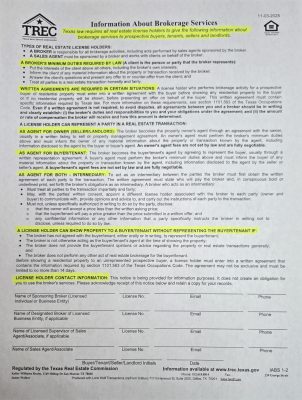
The TREC Information About Brokerage Services form explains broker duties and how Texas real estate professionals may represent buyers, tenants, sellers and landlords.
Texas Uses Intermediary — Not Dual Agency
This distinction is important enough to state clearly: Texas does not permit a broker to act as a dual agent.
When the same broker represents both the buyer and seller, Texas provides for an intermediary relationship if the applicable legal requirements are satisfied. TREC explains that the broker must obtain written consent from both parties, and the representation agreements must authorize intermediary.
TREC provides a consumer explanation in Intermediary relationships – what you need to know.
Another important distinction is that the IABS form itself doesn’t create an intermediary relationship. The IABS is a notice, not a representation agreement. Authorization for intermediary is generally addressed in representation agreements such as a listing agreement or buyer representation agreement.
That’s why I believe consumers should understand what they’re agreeing to rather than simply recognizing the word “intermediary.”
What Happens When Two Agents From the Same Brokerage Are Involved?
Suppose one agent works with the seller and another works with the buyer, but both are associated with the same broker. Consumers may assume the two agents are completely independent because different individuals are involved.
Under an authorized intermediary relationship, however, the broker may appoint separate associated license holders to work with the respective parties. When proper appointments are made, TREC explains that those appointed license holders may provide opinions and advice to the party to whom they are appointed.
The broker remains the intermediary.
Before agreeing to this arrangement, I would ask:
“Will separate license holders be appointed, and what advice will my appointed agent be able to give me?”
That’s something I would want to understand before negotiations begin.
What If Separate Agents Aren’t Appointed?
This distinction is especially important. If an intermediary broker doesn’t appoint separate associated license holders, the intermediary cannot provide opinions or advice to either party or favor one principal over the other.
Think about what that could mean during a negotiation. You may want guidance about price, terms, concessions, or strategy, yet the intermediary’s ability to advocate for one side is restricted.
That doesn’t mean intermediary without appointments is inherently wrong. It means the consumer should understand the limitations before agreeing to the relationship.
What About Family Members or Close Team Members on Opposite Sides?
Suppose a husband and wife work on the same real estate team. One works with the seller while the other works with the buyer. The same question could arise with relatives, business partners, or close team members handling opposite sides of a transaction.
That relationship alone doesn’t automatically mean anything improper has occurred. If both agents are associated with the same broker, however, Texas intermediary requirements may apply depending on the representation relationships involved.
As a consumer, my question would be:
“Do I completely understand these relationships, and am I comfortable with them?”
I’d want to know who represents me, who is working with the other party, whether intermediary applies, whether appointments have been made, and what information must remain confidential.
You deserve to understand those relationships before consenting to them.
One Agent Involved With Both Sides Deserves Careful Scrutiny
Another situation occurs when one individual license holder becomes involved with both the buyer and seller. Perhaps a buyer contacts the listing agent directly, or an existing client becomes interested in one of the agent’s own listings.
Again, don’t casually call this “dual agency.” That isn’t the legal framework Texas uses.
Instead, ask what representation relationship is being proposed and what limitations will apply. If intermediary is involved without separate appointments, restrictions on providing advice and opinions become particularly important.
For me, the question isn’t simply whether an arrangement is legally permitted. I would also ask:
“Am I getting the level of advice and advocacy I want in this transaction?”
Those are two different questions.
The Listing Agent Doesn’t Automatically Become the Buyer’s Agent
Here’s another situation consumers sometimes misunderstand. You call the listing agent because their number appears on a property. The agent answers questions, arranges a showing, and may help move the transaction forward.
That doesn’t necessarily mean the listing agent represents you.
TREC explains that an unrepresented buyer can purchase one of a broker’s listings without creating an intermediary relationship. In that situation, the listing side continues representing the seller and cannot provide the unrepresented buyer with opinions or advice as though representing that buyer.
That’s why I wouldn’t assume:
“The agent showing me the property must be my agent.”
Ask:
“Who do you represent?”

Before signing, understand who represents you, who represents the other party, whether intermediary applies and whether potential conflicts exist.
Be Careful About Financial Interests Beyond the Commission
Potential conflicts aren’t limited to intermediary. Suppose an agent wants to purchase a client’s property, or perhaps the agent’s relative, business partner, investment company, or associate wants to buy it.
That doesn’t automatically mean misconduct has occurred. However, I would want to understand every relationship and financial interest involved before making a decision.
If the person advising you about your property’s value also has an interest in purchasing it, independent information becomes especially important. Depending on the circumstances, that could include another market-value opinion, an appraisal, another broker’s opinion, or legal advice.
The greater the potential conflict, the more important independent verification becomes.
A Low Price Can Benefit Someone Other Than the Seller
A seller may depend heavily on an agent’s pricing recommendation. If that agent—or someone connected to the agent—also wants to purchase the property, the seller should understand that the buyer and seller naturally have different financial interests in the price.
That doesn’t mean every below-market sale followed by a profitable resale proves wrongdoing. Properties sell below apparent market value for many legitimate reasons.
However, if someone connected to your agent wants to purchase your property, I wouldn’t rely solely on that interested party’s opinion of value. Get independent information.
That can be particularly important with estates, land, investment properties, distressed situations, unusual properties, and other real estate where determining market value may be more complicated.
Compensation Can Create Conflicts Too
Money doesn’t automatically create misconduct, but consumers should understand who is being paid, by whom, and for what.
Real estate transactions can involve compensation, referral arrangements, and relationships with other professionals. Applicable laws and rules govern many of these arrangements, but from a consumer’s perspective, the fundamental question is straightforward:
“Is anyone involved in this transaction receiving compensation or another financial benefit that I should know about?”
A professional should be comfortable explaining the answer.
Representation Should Be Clear Before You Need It Most
The worst time to discover that someone doesn’t represent you the way you thought they did is during a difficult negotiation. That’s why I believe representation should be discussed before you become emotionally or financially committed to a transaction.
Ask who represents you and who represents the other party. Determine whether the same broker is involved on both sides, whether intermediary is being proposed, and whether appointments will be made. Most importantly, understand what advice your real estate professional can and cannot provide.
If you’re preparing to purchase a home, my Texas Home Buying Process |- Complete Guide explains representation, contracts, and other major stages of the buying process.
You’re Allowed to Be Uncomfortable With a Conflict
Something can potentially comply with the law and still make you uncomfortable. You don’t have to agree to a particular representation arrangement simply because someone tells you it’s permitted.
If you’re uncomfortable with the same brokerage being involved on both sides, ask about your alternatives. If relationships among the agents concern you, ask questions. When someone advising you also has a financial interest in the outcome, consider whether independent information or professional advice would help you make a more informed decision.
When choosing a real estate agent, clarity about representation isn’t a technical detail. It’s fundamental to understanding whose interests that professional is there to protect.
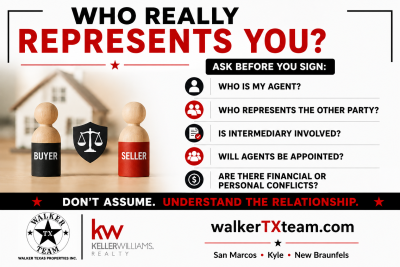
Before signing an agreement, understand who represents you, who represents the other party, whether intermediary applies and whether potential conflicts exist.
When Your Real Estate Agent Is Also Your Lender
There’s another arrangement I’ve been seeing more frequently that I believe buyers should understand before agreeing to it: the same person acting as both your real estate agent and your mortgage loan originator.
This subject requires some nuance. Holding both licenses isn’t automatically improper, and Texas law doesn’t prohibit an appropriately licensed individual from serving in both roles in the same transaction. However, Texas requires advance written disclosure and the client’s written consent before that individual performs both roles. Other state and federal requirements, as well as lender or investor guidelines, may also apply.
So my concern isn’t simply:
“Is this legal?”
For a buyer, I think there’s another important question:
“Is having one person financially involved in both my home purchase and my mortgage the best arrangement for me?”
Two Different Jobs With Different Responsibilities
Your real estate professional and your mortgage professional perform different jobs. Your real estate agent may help you evaluate properties, develop an offer strategy, negotiate terms, manage contract deadlines, coordinate inspections, and navigate the real estate transaction.
Your mortgage loan originator focuses on financing. That can include taking the loan application and helping structure or negotiate the mortgage transaction.
Both professionals can have a significant influence on whether a purchase reaches closing. When one person performs both roles, I believe the buyer should understand exactly how those responsibilities and financial interests interact.
Texas Recognizes the Potential for Conflicts
Texas has a specific Disclosure of Multiple Roles in a Consumer Real Estate Transaction for situations involving someone acting as both a residential mortgage loan originator and a real estate license holder.
The disclosure is important because it specifically recognizes that performing multiple roles creates the potential for conflicts of interest. For example, services performed in one role may affect compensation received in another. The consumer acknowledges those multiple roles and consents to the arrangement.
That doesn’t mean a conflict will occur. It means the possibility is important enough that you should understand it before agreeing to the arrangement.
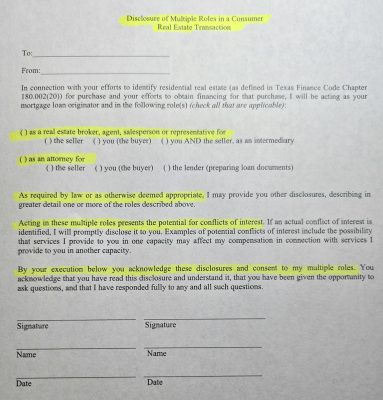
This multiple-role disclosure warns consumers that serving in both real estate and mortgage roles can create potential conflicts of interest.
Follow the Money
I think consumers should understand the financial incentives involved. A real estate professional may earn compensation from the real estate transaction, while a mortgage loan originator may receive compensation associated with originating the mortgage.
That doesn’t mean someone holding both licenses is doing anything improper. Compensation must comply with applicable laws and regulations.
However, from the buyer’s perspective, one individual can potentially have financial interests connected to both the real estate transaction closing and the mortgage being originated. That’s a good reason to ask how the person is compensated in each role.
What Happens When the Best Advice Could Cost the Deal?
Imagine an inspection uncovers serious problems and the buyer is considering terminating the purchase under a contractual right. The real estate side of the conversation should focus on the buyer’s rights, options, and interests within the scope of the agent’s responsibilities.
If that same person is also originating the buyer’s mortgage, a terminated purchase could potentially affect both pieces of business. That doesn’t mean the individual would give improper advice, but it illustrates why a potential conflict exists.
The issue can work in the other direction as well. Financing decisions can affect affordability, closing costs, cash requirements, and whether the transaction proceeds.
I would rather understand those competing financial interests before a difficult decision arises.
Convenience Isn’t the Same as Independence
I understand why combining the roles can sound appealing. One person already knows the transaction and the buyer’s goals, communication may be simpler, and fewer people are involved.
Those can be legitimate conveniences. However, using separate professionals gives you people looking at different parts of the transaction from their respective areas of expertise.
I’ve always valued having experienced lenders, title professionals, inspectors, attorneys when necessary, and other specialists performing their respective jobs. Good professionals should communicate with one another, but they don’t necessarily need to be the same person.
You Have the Right to Shop for Your Mortgage
Regardless of who your real estate agent recommends, you can shop for mortgage financing. Comparing lenders can help you evaluate more than the advertised interest rate.
Depending on the loan, you may want to compare APR, lender fees, points, loan structure, mortgage insurance, cash required to close, and other terms. A mortgage can affect your finances for years after the real estate transaction has closed.
Mortgage preparation and financing are also important parts of the buying process, which I cover in my Texas Home Buying Process – Complete Guide.
Lender Recommendations Should Benefit the Client
Even when your real estate agent isn’t personally originating your mortgage, transparency still matters when lenders are recommended.
There’s nothing inherently wrong with an agent recommending a lender. Experienced real estate professionals often become familiar with lenders who communicate well, understand different types of transactions, and have demonstrated an ability to work effectively with clients.
However, the recommendation should be made because the agent believes the lender may serve the client well—not because of an undisclosed financial incentive for sending business in that direction.
If you’re ever unsure why a particular lender is being recommended, ask.
Questions I Would Ask Someone Offering to Do Both
If an agent offers to handle both your real estate representation and your mortgage origination, I wouldn’t automatically assume something is wrong. I would ask questions.
Are you properly licensed for both roles?
How will you be compensated in each role?
What written disclosures and consents apply?
Am I free to use another lender?
How do the loan terms you’re offering compare with other lenders?
What happens if I terminate the real estate transaction?
What happens if I decide to obtain financing somewhere else?
And perhaps most importantly:
“How do you protect my interests if your financial interests in these two roles ever conflict?”
A professional offering both services should be comfortable answering those questions. Their answers should help you understand the potential conflicts, how they would protect your interests, and whether using one person for both roles is the right choice for you.
Verify Both Licenses
Earlier in this guide, we covered how to verify a Texas real estate license through TREC. If someone is also offering to originate your mortgage, verify that credential as well.
The Texas Department of Savings and Mortgage Lending directs consumers to NMLS Consumer Access to research mortgage professionals and licensing information.
For the real estate side, return to Verify a Texas Real Estate Agent Before You Hire Them earlier in this guide for the TREC verification process.
The point is simple: verify both professional credentials rather than relying solely on what appears on a website, advertisement, or business card.
My Preference Is Separation
This is one area where I want to distinguish between what may be legally permitted and my own professional preference.
Personally, I prefer separation.
I want my buyer to have a real estate professional concentrating on the real estate transaction and a mortgage professional concentrating on the financing. That gives the buyer another professional perspective and reduces the possibility that compensation from multiple roles could influence—or appear to influence—the advice being provided.
Could someone be excellent at both jobs and conduct themselves ethically? Absolutely. My point isn’t that consumers should automatically reject someone who holds both licenses.
My point is that you should understand the potential conflict, ask questions, compare your alternatives, and make the decision knowingly.
When choosing a real estate agent, convenience should never replace transparency.

One professional serving as both agent and mortgage loan originator can create convenience. Consumers should understand compensation, choices, loan terms and potential conflicts.
Reviews, Production Numbers and Online Marketing — What They Tell You and What They Don’t
When choosing a real estate agent, most consumers eventually do what we all do when evaluating a business today: they Google them. I think that’s a smart place to start.
Online reviews, transaction history, production numbers, awards, websites, social media, and professional profiles can all provide useful information. However, none of those things should be viewed by itself as proof that someone is qualified to represent you.
Online presence is evidence to evaluate—not proof of competence.
A polished website doesn’t automatically make someone a great agent. Neither do hundreds of reviews, thousands of social media followers, impressive production numbers, or a collection of awards.
Taken together, though, those things can help you build a clearer picture of the professional you’re considering.
Read the Reviews Instead of Just Counting the Stars
A five-star rating looks impressive, but I think the actual words clients use are often more valuable than the average rating.
Look for details and patterns. Are clients talking about communication, negotiation, local knowledge, responsiveness, contract explanations, or how the agent handled a difficult situation?
You may also find reviews describing experience with acreage, new construction, waterfront property, or another type of real estate relevant to your transaction. Those details tell you considerably more than a short review that simply says:
“Great REALTOR®. Highly recommend!”
Recency matters too. An agent may have accumulated excellent reviews over many years, but I would also want to know what recent clients are saying.
You’re hiring the professional today, so current feedback deserves attention.
Verified client reviews can provide useful insight into a real estate agent’s communication, service and performance during actual transactions.
One Negative Review Doesn’t Tell the Whole Story
I wouldn’t automatically eliminate an agent because of one negative review. Real estate transactions involve money, negotiations, emotions, and circumstances that professionals can’t always control.
Instead, look at the overall pattern. Consider what the complaint actually says, whether it’s specific, and how the agent or business responded.
Repeated complaints about the same issue deserve more attention than one isolated disagreement among years of detailed positive feedback. Likewise, a professional response to criticism can tell you something about how the agent handles difficult situations.
The goal isn’t to find someone whom nobody has ever criticized. You’re looking for patterns that help you make a more informed decision.
Don’t Stop With One Review Platform
Google is one of the first places I would look because its reviews are easy for consumers to find. Still, I wouldn’t make a decision based on one platform alone.
Reviews and recommendations may also appear on real estate websites, social media, brokerage profiles, and other legitimate sources. You can even ask an agent whether recent clients are willing to discuss their experience.
The National Association of REALTORS® provides additional consumer guidance through Questions to Ask When Choosing a Real Estate Agent.
You don’t need to locate every review ever written about someone. Look for consistency among the sources you can reasonably evaluate.
Be Careful With Production Numbers
Real estate production numbers can sound impressive:
“$100 million sold.”
“500 homes sold.”
“Top-producing agent.”
“#1 team.”
Those claims may be completely legitimate, but the number needs context before it tells you very much.
Ask what the number represents. Is it one agent’s personal production, a team’s combined production, or the entire brokerage?
Also determine the period involved. A career total means something different from production during the past 12 months, while sales volume isn’t the same measurement as the number of completed transactions.
Don’t be impressed by a large number until you understand what the number actually represents.
Team Production and Individual Production Aren’t the Same Thing
A successful real estate team may legitimately advertise its combined production. That can tell you something about the organization’s overall experience, systems, and transaction activity.
However, if you’re interviewing an individual agent on that team, I would still ask:
“How much of that production or transaction experience is yours?”
The answer doesn’t diminish the value of a strong team. An agent may benefit considerably from experienced leadership, established systems, administrative support, and knowledgeable colleagues.
The important issue is transparency. Know whether the numbers being presented belong to the individual agent, the team, or the brokerage.
Recent Production Matters Too
Career production can demonstrate longevity and substantial experience, but I also want to know whether someone is actively practicing real estate today.
An agent may have completed hundreds of transactions over a long career while handling relatively few in recent years. Another professional may have fewer lifetime transactions but be highly active in today’s market.
That’s why production numbers should include some indication of when the transactions occurred. Current activity keeps an agent involved with today’s contracts, negotiations, financing environment, technology, market conditions, and transaction practices.
As we discussed earlier in this guide, years licensed and relevant experience aren’t necessarily the same thing.
Understand What an Award Actually Represents
I’ve received professional awards during my career, and I’m proud of them. Still, I wouldn’t tell a consumer to hire an agent simply because there are plaques on the wall.
Find out what an award recognizes. It might represent sales production, peer recognition, client satisfaction, community involvement, or achievement within a brokerage or professional association.
Other awards may be connected primarily to advertising or promotional programs.
Those aren’t all equivalent. An award can provide useful information, but it shouldn’t end your investigation.
Social Media Popularity Isn’t the Same as Real Estate Competence
Real estate and social media have become closely connected. An agent who understands Facebook, Instagram, YouTube, video, and other digital platforms may have valuable marketing skills.
For a seller, that ability can help expose a property to a larger audience. Consistently publishing useful local information may also demonstrate that an agent understands the community they claim to serve.
However, being a successful content creator and being a competent real estate professional aren’t necessarily the same thing.
Someone can be outstanding on camera but weak with contracts. Another agent may have a modest social following and decades of experience negotiating complicated transactions.
Ideally, you want professional competence combined with effective modern marketing. Don’t automatically mistake popularity for qualification.
An Agent’s Website Can Tell You Something
I would absolutely look at an agent’s website, but not because an attractive website proves competence. Pay attention to what the agent actually publishes.
Does the website provide useful information about buying, selling, communities, and property types? Original local content can also help demonstrate whether someone has invested time in understanding the market they claim to serve.
Generic property-search pages and articles that could belong to an agent anywhere in the country tell you something different.
For an example of the kind of local information, I believe consumers should be able to find from a local real estate professional, see my Living in San Marcos TX: What’s It Like?.
Advertising Tells You Who Paid to Be Seen
Consumers encounter real estate advertising everywhere—Google, social media, real estate websites, mailers, billboards, and other platforms.
There’s nothing inherently wrong with advertising. Successful real estate professionals often invest heavily in marketing their businesses and their clients’ properties.
Just remember that advertising primarily tells you who paid to be seen. It doesn’t necessarily tell you who is best qualified to represent you.
The same caution applies when an agent’s photograph appears next to a property on a real estate website. That person may be an advertiser or someone purchasing leads rather than the listing agent.
Marketing can introduce you to an agent. Your research should determine whether you hire them.
Let the Evidence Build a Consistent Picture
By this point in your research, different pieces of information should begin supporting—or contradicting—one another.
License history can help establish professional background, while recent transactions provide evidence of current activity. Education, local knowledge, website content, production numbers, and reviews add different pieces to the picture.
No single item proves that you’ve found the right real estate agent. However, when the information consistently supports what the agent told you during the interview, that’s much more meaningful than one impressive statistic or five-star rating.
That’s how I would use online information when choosing a real estate agent: as evidence that helps you evaluate the claims being made.
The principle we’ve returned to throughout this guide still applies:
Marketing should give you things to investigate—not things you’re required to believe.
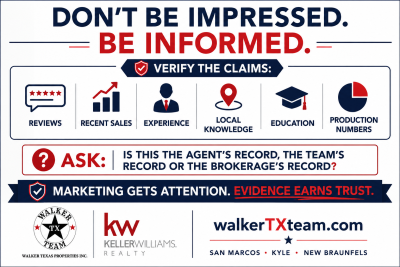
Marketing can get attention, but evidence builds trust. Verify reviews, recent sales, experience, local knowledge, education and production claims before choosing an agent.
Communication, Availability and Responsiveness — What Happens After You Hire the Agent?
You can research an agent’s license, experience, education, local knowledge, reviews, and production history and feel confident you’ve made a good choice. Then you hire them—and can’t get them to return your call.
That’s why communication deserves its own place in this guide. Earlier, we discussed whether an agent works full-time or part-time and has adequate availability; now we’re looking at a different question: What will communication actually look like once you’re a client?
Real estate doesn’t operate exclusively from 9:00 to 5:00, Monday through Friday. Showings happen after work, offers can arrive at night, inspection issues develop, and contractual deadlines don’t necessarily fall during convenient business hours.
A good agent doesn’t need to answer every telephone call instantly or be available 24 hours a day. You do need to understand how communication will work before you need an urgent answer.
Discuss Communication Before You Hire the Agent
People communicate differently, and there isn’t one method that’s right for every client. Some people prefer telephone calls or texts, while others want important information documented by email.
Your agent’s communication style should work reasonably well with yours. Before hiring someone, I would start with:
“How do you normally communicate with your clients?”
Then get more specific:
“If I text or call you, when should I normally expect a response?”
“What should I do if something is urgent?”
“How do you handle evenings and weekends?”
“If you’re unavailable, who do I contact?”
Establishing those expectations before you hire the agent can prevent considerable frustration later.
Texas Has a Rule About Timely Responses
Responsiveness isn’t merely a customer-service issue in Texas. TREC Rule §535.157 requires brokers and sales agents to respond to certain transaction-related communications within two calendar days. The rule applies to communications from their clients, another agent involved in the transaction, or an unrepresented party.
Weekends and holidays count because the rule specifies calendar days. Importantly, the agent only needs to respond within that period, not necessarily resolve the underlying issue.
Texas consumers can read TREC’s explanation in How to Comply With the New Response Time Rule.
However, I would distinguish between a regulatory requirement and the communication standard you expect from the person representing you. Two calendar days can be a long time during a real estate transaction.
An offer may expire that evening, or an inspection deadline could be approaching. A seller might also need to make a decision while several offers are being considered.
Instead of simply asking whether an agent complies with TREC’s rule, ask:
“What response time can I realistically expect from you?”
Know Who You’ll Actually Be Communicating With
This is particularly important when interviewing an agent who works as part of a team.
You may meet with one person during the initial consultation and assume that person will handle every conversation afterward. In some businesses, however, different people handle different parts of the transaction.
There’s nothing inherently wrong with that structure. A team may provide excellent service precisely because responsibilities are divided among people with different roles.
The important thing is understanding the arrangement before you hire the agent.
Ask who will communicate with you about showings, offers, inspections, negotiations, contract questions, and closing. You should know who is responsible for what.
Administrative Support and Representation Aren’t the Same Thing
Transaction coordinators, assistants, marketing staff, and other support professionals can play valuable roles in a real estate business. They may help coordinate documents, appointments, deadlines, signatures, marketing tasks, and communication.
However, administrative support shouldn’t leave you wondering who is actually providing your real estate representation.
If you hire an agent because of that person’s experience, judgment, or negotiation ability, ask how involved that agent will remain once you’re under contract. Find out who handles professional advice and negotiations versus administrative coordination.
Delegating tasks can improve service. You should still know who is responsible for representing your interests.
Communication Matters Most When Something Changes
Routine updates are important, but communication becomes especially valuable when a transaction doesn’t go according to plan.
An inspection may uncover a serious issue. Financing could encounter a problem, an appraisal may create questions, or the other party might propose an unexpected change.
During those moments, I don’t want a client wondering whether their agent received the message or who is supposed to call them back. The communication system should already be established.
This is also when experience and judgment matter. Fast communication is useful, but a quick response isn’t enough if the information being provided is incomplete or poorly considered.
The goal is timely, useful communication.
Good Communication Includes Explaining What’s Happening
Responsiveness isn’t simply returning calls and texts. A good real estate professional should also help you understand what’s happening and what decisions may be ahead.
That doesn’t mean predicting every possible problem. It means keeping clients reasonably informed about the transaction, important deadlines, new developments, and issues requiring attention.
Sometimes the update may simply be that nothing significant has changed. For many clients, knowing that their agent is actively following the transaction provides valuable reassurance.
Silence shouldn’t leave you wondering whether anyone is paying attention.
Communication During Negotiations Deserves Special Attention
Negotiations are one of the times when communication can directly affect your options. An offer or counteroffer may contain a deadline. Another buyer could enter the picture, or a seller may be considering several offers at once.
You need enough time to understand the information, ask questions, and make your own decision. Your agent also needs a reliable way to reach you. Communication therefore works both ways.
Your agent should explain how to reach them. You should also discuss how they can contact you when a decision is time-sensitive.
Different Clients Need Different Levels of Communication
Some clients want frequent updates and detailed explanations. Others prefer to hear from their agent only when something requires attention.
Neither approach is inherently better.
A strong communication system should account for those differences rather than forcing every client into exactly the same pattern. That’s one reason I think communication preferences should be discussed at the beginning of the relationship.
Ask yourself whether the agent seems willing to communicate in a way that works for you while still maintaining the documentation and professional practices the transaction requires.
Questions I Would Ask Before Hiring the Agent
Before choosing a real estate agent, I would want clear answers to several communication questions:
What response time should I normally expect?
How do you prefer to communicate—telephone, text, email, or a combination?
How are urgent matters handled?
What happens during evenings and weekends?
Who covers for you when you’re unavailable or on vacation?
Will I primarily communicate with you or someone else on your team?
Who handles negotiations and contract questions?
Will a transaction coordinator or assistant be involved?
How will you keep me informed when there isn’t a major update?
You don’t need an agent who promises to answer every call within 30 seconds. You need a communication system you understand and can rely on when the transaction requires it.
Responsiveness Is Part of Representation
Communication alone doesn’t make someone a great real estate agent. A person can respond instantly and still lack the experience, contract knowledge, local expertise, or judgment your transaction requires. However, even a highly qualified agent can’t provide much guidance if you can’t reach them when an important decision needs to be made. That’s why I consider communication part of the complete professional.
The goal isn’t constant access—it’s dependable communication when it matters.
Before choosing a real estate agent, understand how communication will work after you hire them. Make sure that system fits the level of service and representation you expect.

Experienced real estate professionals review documents and discuss transaction details, illustrating the value of knowledge, communication, and professional support.

Before choosing a real estate agent, ask about response times, after-hours communication, backup coverage, and who handles urgent issues.
What Are You Actually Paying For? Real Estate Commissions, Compensation and Representation Agreements
Few subjects in real estate generate more confusion than compensation. Consumers hear about commissions, buyer-agent fees, listing fees, retainers, upfront fees, and termination fees. Recent changes to real estate rules and Texas forms have made understanding these terms even more important.
The basic principle remains simple: Real estate broker compensation is not set by law. It is negotiable. Current National Association of REALTORS® policy requires written buyer agreements to clearly disclose that broker fees and commissions are negotiable. The agreement must also establish the broker’s compensation or explain how it will be determined.
Instead of asking only, “What percentage do you charge?” I recommend asking, “What could I owe, when could I owe it, and what services am I receiving?”
That question provides a much clearer picture of the financial relationship you’re considering.
There Is No Legally Required “Standard Commission”
Real estate compensation is established through agreements between brokers and their clients. Sellers negotiate compensation with listing brokers, while buyers negotiate services and compensation with their brokers.
Consumers should never assume there is a government-established or legally required “standard commission.” A brokerage has its own fee structure, and certain arrangements may be common within a market. However, common and legally required are two very different things.
Current NAR rules also require compensation in written buyer agreements to be objectively ascertainable rather than open-ended. The agreement must state the amount or rate or clearly explain how compensation will be determined.
The National Association of REALTORS® explains these requirements in its Consumer Guide to Written Buyer Agreements.
Texas Changed the Rules for Residential Buyers in 2026
Texas buyers who purchased homes years ago may remember calling an agent and immediately going to see houses. Beginning January 1, 2026, Texas established new written-agreement requirements for prospective residential buyers.
A license holder must enter into a written agreement before showing residential property to a prospective buyer. If no property is shown, the agreement must be signed before presenting an offer.
The agreement must address services, termination, exclusivity, representation status, and broker compensation. It must also disclose that broker compensation is not set by law and is negotiable.
If you’re wondering, “Why is this agent asking me to sign something before we look at a house?” there is now a specific Texas-law reason.
However, signing shouldn’t become a meaningless formality. Read it, understand it, and ask questions before you sign it.
Consumers can review TREC’s explanation in What Changes in 2026 About Buyer/Tenant Representation in Texas.
A Showing Agreement and a Representation Agreement Are Different
The 2026 Texas changes created another distinction consumers should understand. Texas provides a framework allowing license holders to show residential property without representing the prospective buyer.
Specific requirements must be satisfied for this type of non-representation arrangement. The license holder cannot have agreed to represent the buyer or provide opinions about the property. General real estate advice and other brokerage services are also limited under this arrangement.
That makes one question especially important:
“Are you representing me, or are you only showing me this property?”
Those are different relationships with different services and responsibilities. Never assume someone represents your interests simply because they are helping you access a property.
This connects directly with our earlier discussion about Who Does the Agent Really Represent? Intermediary, Both Sides and Potential Conflicts.
Your Buyer Agreement Should Explain Broker Compensation
A buyer representation agreement does more than establish who represents you. It should also explain how your broker will be compensated.
Current NAR MLS policy requires written buyer agreements to clearly disclose the amount or rate of compensation. Alternatively, the agreement may explain how that compensation will be determined. The amount cannot simply be left open-ended.
Compensation can be structured differently depending on what the parties negotiate. Examples may include a percentage, flat fee, hourly fee, or another agreed compensation structure.
The important point is to know what your agreement says before you sign it.
Does the Buyer Always Pay the Buyer’s Broker Out of Pocket?
Not necessarily. A buyer may agree to compensate the buyer’s broker under the representation agreement, but some or all of that compensation may come from another permitted source.
Depending on the transaction, that source could include the seller or listing broker. NAR’s consumer guidance explains that buyers may also request and negotiate for sellers to compensate their real estate professionals.
The important question is:
“What does my agreement say I owe, and what happens if another source doesn’t cover that amount?”
Ask that question before writing an offer, not at the closing table.
Buyer-Agent Compensation Is No Longer Offered Through the MLS
How buyer-agent compensation is communicated changed significantly in 2024. Offers of compensation to buyer brokers can no longer be communicated through an MLS subject to NAR’s rules.
That doesn’t mean sellers are prohibited from offering buyer-agent compensation. Compensation may still be offered through permitted methods outside the MLS or negotiated within the transaction.
That’s an important distinction: No compensation offer in the MLS doesn’t mean compensation cannot be offered.
NAR explains the current system in its Offers of Compensation
Consumers who bought or sold before 2024 may find that today’s transaction looks different. Buyer-agent compensation didn’t disappear, but consumers should understand how their particular transaction handles it.
Sellers Have Compensation Decisions Too
Sellers should understand what they’re agreeing to pay their listing brokerage and which services are included. Ask about broker compensation, additional charges, included services, and when each amount becomes payable.
A seller may also face decisions involving compensation for a buyer’s representative. Those choices should be discussed as part of the transaction strategy rather than treated as automatic expenses. NAR’s current guidance states that offers of compensation aren’t mandatory.
NAR provides additional information in its Consumer Guide to Listing Agreements For more about preparing and selling a Texas property, see my Texas Home Selling Process: Complete Step-by-Step Guide.
Retainers and Upfront Fees Deserve Attention
Some brokerage agreements may include money due before a transaction closes. Texas REALTORS® revised its Buyer/Tenant Representation Agreement – Long Form (TXR 1501) for 2026 to accommodate an optional retainer.
That doesn’t mean every broker charges a retainer, nor does Texas law require every buyer to pay one. Instead, the form allows the broker and buyer to negotiate such an arrangement.
If you’re asked for a retainer, determine what it covers and when it becomes earned. Find out whether any portion is refundable or credited toward other broker compensation.
Sellers may encounter brokerage models with upfront fees as well. Those charges might cover photography, advertising, staging consultations, administrative expenses, or other professional services.
Before paying an upfront fee, understand what it covers and whether any portion is refundable or credited toward another amount due later. An upfront charge should never be an unexplained charge.
Consumers can review the changes in the Texas REALTORS® 2026 Forms Changes
Don’t Overlook Termination Fees
Consumers naturally focus on what they’ll pay if a transaction closes. However, you should also understand what could happen financially if the brokerage relationship ends early.
Before signing, ask:
“Can I terminate this agreement before it expires, and could I owe anything if I do?”
Review whether the broker must agree to release you. Also determine whether an early-termination fee, compensation obligation, or protection period could survive termination.
Texas REALTORS® revised its Termination of Buyer/Tenant Representation Agreement (TXR 1503) for 2026. Those revisions addressed termination fees, signatures, protection periods, and provisions that may survive termination.
TREC also cautions that buyer representation agreements are legally binding contracts. A buyer can request a release, but TREC cannot require a broker to provide one.
TREC addresses this issue in Can I cancel a Buyers Representation agreement?
Compare Cost With the Services You Receive
A lower commission or fee doesn’t automatically mean better value. Likewise, a higher fee doesn’t automatically mean better representation.
Sellers should compare compensation with the services being provided. Those services may include pricing strategy, photography, marketing, communication, contract management, negotiation, and problem-solving.
Buyers should evaluate what’s included on their side of the transaction. Property research, offer preparation, negotiation strategy, inspections, financing coordination, deadline management, and assistance through closing may all be important.
Most importantly, compare those promises with the services stated in your written agreement. Texas’s 2026 requirements specifically require residential-buyer agreements to identify the services being provided.
My Texas Home Buying Process – Complete Guide explains where knowledgeable representation can become particularly valuable during a transaction.
The difference between two fees matters. So does the difference between what you receive for those fees.
Understand the Agreement Before You Sign
Don’t stop reading when you find the commission or compensation provision. Review the agreement’s duration, exclusivity, property scope, services, compensation, retainers, upfront fees, and termination provisions.
Also determine whether any financial obligations continue after termination. These provisions can matter even when you never purchase or sell a property.
TREC doesn’t promulgate the buyer representation agreement. Instead, it is a private contract between the buyer and real estate broker. Organizations such as Texas REALTORS® provide forms their members may use.
TREC explains this distinction in Does TREC have a promulgated buyer representation agreement?
The form may be familiar to the real estate professional who works with it regularly. That doesn’t mean you should treat it casually.
If you don’t understand something, ask before signing. For questions requiring legal interpretation, consider consulting an attorney.
What Are You Actually Paying For?
Compensation matters, and consumers should understand and negotiate the financial terms of their brokerage agreements. Price alone, however, doesn’t tell you whether you’re receiving good value.
Compare compensation with the services you will actually receive. Then consider the agent’s experience, local knowledge, contract knowledge, communication, availability, and ability to handle your type of transaction.
Before signing, make sure you understand every potential fee and when it could become payable.
Instead of asking only, “What’s your commission?” ask:
“What could I owe, when could I owe it, and what am I receiving in return?”
That question gives you a much clearer picture of the professional and financial relationship you’re considering.

Before hiring a real estate agent, understand every potential fee, when it may be owed, and what services the agreement includes.
How Will the Agent Actually Market Your Property?
When sellers interview real estate agents, much of the conversation naturally centers on price and commission. Those are important subjects, but I believe every seller should ask another question before signing a listing agreement:
“Exactly how are you going to market my property?”
Putting a property into the MLS is an important part of reaching buyers, but it isn’t a complete marketing strategy by itself. Good marketing begins with understanding the property, what makes it different, and how those features should be presented.
The strategy should also fit what you’re selling. Marketing a residential home shouldn’t necessarily look like marketing acreage, waterfront property, luxury real estate, commercial property, or vacant land.
Marketing Should Begin Before the Listing Goes Live
Some of the most important marketing decisions happen before buyers ever see the property online. Preparation may involve repairs, decluttering, staging, photography, gathering property information, and identifying features worth emphasizing. Timing matters too, because I don’t believe the goal should be getting a property into the MLS as quickly as possible. The goal should be introducing it to the market correctly.
Buyers already watching the market may notice a new listing almost immediately. Poor photographs, incomplete information, or weak presentation can waste that initial opportunity. Before going live, I want the property prepared and the marketing materials ready. Sellers should ask what happens before launch and how the agent plans to make that first impression count.
Professional Photography Is Only the Beginning
Photography matters because a property’s first showing often happens on a screen. Before scheduling an appointment, buyers may review photographs, location, property details, and competing listings. Sellers should ask who takes the photographs, whether professional photography is included, and whether the number of images makes sense for the property.
Depending on what you’re selling, aerial photography, drone video, floor plans, virtual tours, or property videos may add value. However, more media doesn’t automatically mean better marketing. Aerial photography can help explain acreage or waterfront property, while a floor plan may clarify an unusual layout. Video can show how spaces and property features connect.
The important question is: “Does this marketing tool help buyers better understand or appreciate this particular property?”
The Property Description Still Matters
Photos attract attention, but words provide context. A good listing description shouldn’t simply repeat information buyers can already see in the MLS fields. If the MLS provides the bedroom count, bathrooms, and square footage, the description has an opportunity to communicate something more meaningful.
That might include river access, acreage, mature trees, architectural details, outdoor living, views, improvements, or another distinctive feature. Accuracy matters just as much as creativity. Marketing should help buyers understand a property’s strengths without exaggerating features or making claims that cannot be supported. I believe the strongest descriptions answer a simple question:
“Why should a buyer take a closer look at this particular property?
Where Will Buyers Actually See the Listing?
One of my favorite questions for sellers to ask during a listing presentation is:
“After you put my property in the MLS, what happens next?”
The What Is The Multiple Listing Service (MLS)? can provide broad exposure through participating real estate websites and brokerage platforms. Sellers should also understand what the agent actively plans to do beyond that distribution.
Will the property appear on the agent or team website? Does the strategy include social media, video, open houses, property-specific channels, or direct communication with other real estate professionals? Paid advertising may also be appropriate for some listings, so ask where it will be used and why.
Most importantly, distinguish between exposure that happens automatically through MLS syndication and marketing the agent actively creates. Those aren’t necessarily the same thing.
For a broader look at the selling process, my Texas Home Selling Process The Complete Step-by-Step Guide covers preparation, pricing, marketing, negotiations, contract-to-close, and closing.
Social Media Should Have a Purpose
Social media can expose a property to people who may not be actively searching real estate websites. It also gives sellers, agents, and others an easy way to share the listing with a wider audience. However, simply saying “I’ll put it on Facebook” isn’t a marketing strategy.
Ask which platforms the agent plans to use and how those platforms fit the property being marketed. A riverfront home, acreage property, luxury listing, or typical residential home may benefit from different audiences and approaches.
Promotion should also extend beyond a single post when appropriate. Local community groups, specialized real estate groups, and other targeted channels may provide additional exposure when their rules allow property marketing.
Social media should support the overall property strategy rather than replace it.
Verify the Agent’s Marketing
Earlier in this guide, I explained that an impressive online presence doesn’t automatically make someone a great real estate agent. That remains true. A polished website or large social following doesn’t prove contract knowledge, negotiation ability, ethics, or professional judgment.
However, digital presence becomes relevant when someone claims expertise in marketing property. Look at the agent’s website, current listings, photography, descriptions, videos, and social media. Search the agent’s name and business to see what potential buyers will find.
Then ask to see examples of properties they’ve actually marketed, especially properties similar to yours. If you’re selling acreage, review their acreage marketing. For waterfront or luxury property, ask how they’ve presented comparable listings.
Don’t just ask what the agent can do. Verify what the agent has actually demonstrated.
Marketing Must Fit the Property
This is especially important in Central Texas because property types can vary dramatically. Someone considering a typical residential home may need very different information than a buyer evaluating 25 acres, a waterfront property, or commercial real estate.
Land buyers may want details about boundaries, access, surveys, utilities, water, wastewater, terrain, easements, restrictions, floodplain considerations, and potential uses. Waterfront buyers may have additional questions about water access, property boundaries, flooding, improvements, and the surrounding setting.
The marketing should give buyers the information they need to evaluate that particular property. Depending on the property, that may require maps, aerial photography, video, or other specialized marketing materials.
For example, video made sense when I marketed a riverfront home on the San Marcos River in Martindale. Photographs could show the house, but video provided another way to experience the riverfront setting and see how the property connected to the water.
541 Martindale Falls Road – San Marcos River Front Home
The same principle applies to acreage, farm and ranch properties, luxury homes, commercial real estate, and other specialized properties. Each may require a different combination of information and marketing tools to help potential buyers understand what makes the property distinctive.
The marketing strategy should fit the property rather than forcing every listing into the same template.
Who Is Responsible for the Marketing?
Agents often work with photographers, videographers, marketing coordinators, and other professionals. I see value in that approach because specialists can improve the final product. What matters is knowing who remains responsible for the strategy and quality control.
Ask who writes the description, reviews the photography, creates digital content, monitors the listing, and decides when something should change. Using a team doesn’t remove the listing agent’s responsibility. Someone should be evaluating how the property is presented and whether the marketing continues to serve the seller’s goals.
In my view, delegating a marketing task isn’t the same as delegating responsibility for the result.
What Happens If the Property Doesn’t Sell?
Another revealing question is:
“What will you do differently if my property is still on the market 30, 60, or 90 days from now?”
A marketing strategy shouldn’t disappear after launch week. If the property isn’t generating the expected response, the agent should evaluate what the market is telling you.
Are buyers viewing the listing but not scheduling showings? Perhaps people are touring the property without making offers, or feedback is revealing a recurring concern. Competitive inventory and recent sales may have changed, while presentation, condition, or pricing may also deserve another look.
The answer isn’t always more advertising. Sometimes effective marketing provides good exposure and reveals that the obstacle lies somewhere else.
A good agent should help distinguish between an exposure, presentation, condition, or pricing problem before recommending the next move.
Marketing Creates Opportunity, Not a Guarantee
Even outstanding marketing doesn’t guarantee that a property will sell. Marketing creates attention, exposure, and opportunities for buyers to discover and understand the property. After that, the other parts of representation become critical, including pricing, communication, contract knowledge, negotiation, problem-solving, and professional judgment.
A beautiful video can’t negotiate an offer, while professional photographs can’t interpret a contract. Thousands of online views also don’t necessarily produce a qualified buyer. That’s why I wouldn’t choose a listing agent based solely on marketing.
However, I also wouldn’t hire someone without understanding how they plan to present my property. Before signing, ask:
“What will you do to give my property the best reasonable opportunity to reach and connect with the right buyers?”
Then ask the agent to show you the evidence. Don’t just ask. Verify.

Effective real estate marketing combines strong presentation with a strategy tailored to the property and the buyers most likely to consider it.

Don’t just ask whether an agent will market your home. Ask how the property will be marketed, measured, and adjusted if it doesn’t sell.
Red Flags I Wouldn’t Ignore When Choosing a Real Estate Agent
After everything we’ve covered, you can probably see why I don’t believe one qualification identifies the right real estate agent. There also isn’t one automatic red flag that tells you someone is the wrong choice.
A newly licensed agent isn’t automatically unqualified, while a part-time agent isn’t necessarily a poor choice. One negative review doesn’t prove someone provides bad service. Likewise, living outside the community where an agent works doesn’t automatically mean they lack local knowledge.
What concerns me more is a pattern. When several warning signs begin appearing together, or an agent becomes uncomfortable with reasonable questions, I would pay closer attention.
They Don’t Want You to Verify What They’re Telling You
One of the strongest themes throughout this guide has been:
Don’t just ask. Verify.
A professional shouldn’t be threatened because you check their Texas real estate license, education, disciplinary information, reviews, or recent transaction experience. In fact, I think a professional should expect you to do some homework before choosing a real estate agent.
I’d become concerned if someone discouraged independent research or became defensive about reasonable questions. Checking a professional’s qualifications isn’t an insult.
You’re deciding whether to trust someone with an important professional responsibility.
Their Answers Stay Vague When You Ask About Experience
There is a big difference between saying:
“I’ve been doing this for 20 years.”
and explaining what you’ve actually done during those 20 years.
If I repeatedly heard statements such as “I sell everywhere,” “I’ve done everything,” or “Don’t worry, I know how to handle it,” I would start asking more specific questions.
Ask:
“When was your most recent transaction in this area?”
“Have you represented this type of property before?”
“What experience do you have with transactions similar to mine?”
An agent doesn’t need to reveal confidential information about previous clients. However, they should be able to discuss their professional experience in meaningful terms.
Confidence isn’t a substitute for specifics.
They Claim to Be an Expert Everywhere
Real estate agents can serve large geographic areas, but that doesn’t mean anyone is equally knowledgeable everywhere. If someone claims deep expertise across an enormous territory, I would want evidence supporting that claim.
The same principle applies to property types. Residential homes, acreage, farm and ranch, waterfront property, commercial real estate, investment property, and new construction can involve very different issues.
I’d rather hear an agent say:
“That’s outside my strongest area, but here’s how I would get the right expertise involved.”
That’s more reassuring to me than someone pretending every market and property type falls comfortably within their expertise. Recognizing the limits of your knowledge is an important professional skill.
They Can’t Clearly Explain the Documents They’re Asking You to Sign
Real estate professionals aren’t attorneys, and there are limits to the legal advice a license holder can provide. However, an agent asking you to sign a real estate form should understand how that document functions within the transaction.
That includes representation agreements, listing agreements, contracts, addenda, notices, and other relevant documents. I would be concerned by responses such as:
“Everybody signs it.”
“It’s just standard.”
“Don’t worry about that paragraph.”
or:
“Just sign it and I’ll explain it later.”
A professional may appropriately tell you that a particular legal question requires an attorney. That’s very different from being unable to explain the real estate form they’re asking you to sign.
They Pressure You to Sign Before You Understand the Relationship
Real estate agreements can create significant contractual and financial obligations. Representation agreements may address compensation, duration, exclusivity, services, retainers, termination, and other responsibilities.
There may be legitimate reasons a document needs to be completed before moving forward. However, that doesn’t eliminate your right to understand what you’re agreeing to before signing.
I would be cautious of someone who tries to rush you past reasonable questions simply to obtain a signature. Urgency shouldn’t be used to replace understanding.
They Avoid Talking Clearly About Compensation
Compensation shouldn’t be mysterious. If you’re asking about fees, retainers, compensation from another source, or early termination, you deserve a clear explanation of the agreement.
I’d be cautious if an agent described a negotiable fee as legally required or avoided explaining potential charges. The issue isn’t whether the agent charges more or less.
The issue is whether you understand what you could owe and what you’re receiving in return.
We covered compensation and representation agreements in detail in the previous section, so I wouldn’t repeat that entire discussion here. The red flag is simply an unwillingness or inability to explain the financial arrangement clearly.
Their Production Claims Don’t Hold Up to Questions
Production numbers can provide useful information, but they can also become misleading when individual, team, and brokerage production are blended together.
If someone advertises hundreds of transactions or millions of dollars in sales, ask:
“Is that your personal production, the team’s production, or the brokerage’s production?”
There’s nothing wrong with being part of a highly productive team. However, I’d become concerned if the answer changed depending on how the question was asked or the agent couldn’t explain what the number represented.
Impressive numbers should become clearer when you ask questions—not more confusing.
They Become More Interested in Closing Than in Protecting You
This is one of the warning signs I take most seriously. Real estate professionals are generally compensated when transactions close, creating a financial incentive for the transaction to continue.
That doesn’t mean an agent shouldn’t work hard to solve problems and keep a good transaction together. However, protecting the client’s interests should remain more important than protecting the commission.
If a serious issue arises, your agent should help you understand the risks and available contractual options within their expertise. Sometimes continuing with the transaction may still make sense, while other situations may justify further investigation or a different decision.
I would rather work with someone willing to lose a commission than someone willing to protect the commission at the client’s expense.
You Can’t Figure Out Who Actually Represents You
Representation should be understandable. If the same brokerage is involved on both sides, intermediary may apply. Dealing directly with a listing agent also doesn’t automatically mean that person represents you.
When relationships become complicated, ask:
“Who represents me?”
“Who represents the other party?”
“Is intermediary involved?”
“Are there financial or personal relationships I should understand?”
I’d become concerned if reasonable questions about representation consistently produced vague answers. You shouldn’t need to be a real estate professional to understand whose interests your agent is supposed to protect.
A Financial Conflict Comes With Resistance to Verification
Potential conflicts don’t automatically mean misconduct. However, the greater someone’s personal financial interest in your decision, the more important transparency becomes.
For example, if an agent or someone connected to them wants to purchase your property, I would want independent information about value. When the same professional offers both real estate representation and mortgage origination, I would want to understand the licenses, compensation, and required disclosures.
Those arrangements may be permissible under applicable requirements. The red flag is resistance to reasonable questions or independent verification.
Transparency helps you evaluate a potential conflict. Resistance to transparency gives you another reason to investigate.
You Can’t Reach Them and There’s No Backup Plan
Nobody can be available 24 hours a day, and that isn’t the standard I would use. The warning sign is someone who repeatedly disappears when important decisions need to be made and has no reliable backup system.
If the agent is unavailable, find out who can respond and what that person is authorized to handle. Offers, inspection issues, negotiations, and contractual deadlines may require timely attention.
Good service doesn’t require constant access to one individual. It requires a dependable communication system.
Their Marketing Promises Don’t Match the Evidence
If a listing agent promises exceptional marketing, examine their actual work. Review current listings, photography, descriptions, website content, social media, and examples involving properties similar to yours.
A polished listing presentation means very little if the agent’s actual marketing consistently falls short of what was promised. Compare the presentation with the work they are doing for real clients.
The principle is simple:
Don’t evaluate the promise. Evaluate the evidence.
They Tell You What You Want to Hear Instead of What You Need to Know
This warning sign can be difficult to recognize because hearing what we want to hear feels good. A seller may want the highest possible price, while a buyer may want reassurance about a house they’ve fallen in love with.
Professional representation sometimes requires uncomfortable conversations. An agent may tell a seller that the market doesn’t support the price they hoped for. A buyer might hear that an issue deserves further investigation, while another situation may require advice from a different professional.
I don’t expect an agent to be negative. I do expect them to be truthful.
The professional who always agrees with you may not always be the professional protecting you.
One Red Flag Isn’t Always the Whole Story
I want to end this section with some balance. People make mistakes, and one isolated issue doesn’t necessarily define a professional.
An agent can have a bad review. A newer professional may still provide excellent representation, while an experienced agent can occasionally respond slowly. Misunderstandings happen too.
That’s why I would look at the complete picture before making a hiring decision. However, repeated vague answers, exaggerated claims, pressure, poor communication, unexplained fees, questionable conflicts, and resistance to verification shouldn’t be ignored simply because you like the person.
Choosing a real estate agent is ultimately a professional decision. Trust your relationship with the person, but verify the professional behind it.

Don’t just ask—verify. Check an agent’s license, experience, education, disciplinary history, and local knowledge before making your decision.

Frequently Asked Questions About Choosing a Real Estate Agent
Choosing a real estate agent involves more than finding someone with a license or clicking the first name you see online. These answers address common questions buyers and sellers ask when deciding whom to hire.
How Do I Choose a Good Real Estate Agent?
Start by verifying the agent’s license. Then evaluate the qualifications most relevant to your transaction.
Consider recent experience, local knowledge, property-type experience, education, communication, contract knowledge, reviews, and professional track record.
Interviewing more than one agent can also provide useful perspective. Most importantly, don’t rely entirely on what someone tells you about themselves.
Ask questions, then verify the answers when you reasonably can.
How Can I Verify a Real Estate Agent’s License in Texas?
The Texas Real Estate Commission provides an online license-holder search where consumers can verify whether a Texas real estate license is active. The record can also provide other information about the license holder.
Earlier in this guide, I walked through Verify a Texas Real Estate Agent Before You Hire Them step by step. That section explains what I recommend reviewing in TREC records.
What’s the Difference Between a Real Estate Agent, REALTOR® and Broker?
A Texas real estate sales agent is licensed by TREC and must be sponsored by a licensed broker to perform brokerage activities.
A broker has satisfied additional Texas licensing requirements. A broker may operate independently or sponsor sales agents.
REALTOR® identifies a real estate professional who belongs to the National Association of REALTORS® and agrees to follow its Code of Ethics.
The terms are related, but they don’t mean the same thing.
Should I Interview More Than One Real Estate Agent?
Yes, you certainly can. In many situations, I think comparing agents is useful.
Ask each person similar questions about experience, local knowledge, communication, compensation, representation, and the services they provide.
Sellers should also compare pricing recommendations and actual marketing plans.
The objective isn’t necessarily to hire the person who gives you the answers you like best. Instead, understand the reasoning behind those answers.
Then determine which professional best fits your transaction.
Should I Hire the Real Estate Agent Who Has Sold the Most Homes?
Not necessarily. Production can provide useful evidence of experience, but it shouldn’t be your only consideration.
First, determine whether the number represents the individual agent’s production, a team’s combined production, or the brokerage’s production.
Then consider how recent and relevant that experience is to your transaction.
An impressive career sales number doesn’t automatically establish experience with your community, property type, or situation.
Is the Real Estate Agent With the Most Five-Star Reviews Necessarily the Best?
No. Reviews can provide valuable information, particularly when you read what clients actually say instead of looking only at the star rating.
Look for recurring comments about communication, knowledge, negotiation, problem-solving, and service.
Also consider how recent the reviews are and whether similar patterns appear across multiple sources.
Reviews are evidence to consider—not proof by themselves.
Does a Real Estate Agent Need to Know the Area Where I’m Buying or Selling?
Local knowledge can be extremely valuable, but don’t measure it simply by where the agent lives or where their office is located.
Ask about recent transactions in the area. Listen to how specifically the agent can discuss the community.
In Central Texas, relevant knowledge may include flooding, acreage, wells, septic systems, waterfront property, development, older homes, and new construction.
Other issues can vary substantially from one property or community to another.
The question isn’t simply where the agent lives. It’s whether they know the market where you need them to work.
Is It Better to Hire a Full-Time Real Estate Agent?
Not automatically. A full-time agent may have greater availability and more frequent exposure to current transactions, contracts, and market conditions.
However, full-time status alone doesn’t prove competence.
Likewise, I wouldn’t automatically reject a part-time agent with relevant experience, adequate availability, and a strong professional support system.
Ask how actively the person practices real estate. Also ask how your transaction will be handled when you need assistance.
Should I Hire a Friend or Family Member as My Real Estate Agent?
You can, provided they’re qualified for the job. I would evaluate a friend or relative using the same professional standards as anyone else.
Consider licensing, experience, local knowledge, property expertise, communication, availability, and overall competence.
A personal relationship can be an advantage when it comes with professional qualifications. It shouldn’t replace them.
Do Texas Home Buyers Have to Sign an Agreement With a Real Estate Agent?
Yes, in certain situations Texas law requires a written agreement before a license holder can provide brokerage services to a prospective residential buyer.
However, that agreement does not necessarily have to establish an agency relationship.
Effective January 1, 2026, a Texas license holder performing brokerage activity for a prospective residential buyer generally must enter into a written agreement.
The agreement generally must be in place before the license holder shows residential property.
If no property will be shown, the agreement must be in place before the license holder presents an offer for the prospective buyer.
Depending on the relationship, the agreement may provide for buyer representation. In limited circumstances, an agreement may allow property showings without buyer representation.
Required terms include services, the termination date, exclusivity, representation status, and broker compensation.
It must also conspicuously disclose that broker compensation isn’t set by law and is fully negotiable.
Consumers should understand whether the agreement creates representation before signing it. A written agreement shouldn’t become something you sign automatically without understanding it.
Are Real Estate Commissions Set by Law?
No. Real estate broker compensation is negotiable and isn’t set by law.
Depending on the agreement and brokerage business model, consumers may encounter percentages, flat fees, retainers, upfront fees, or other compensation arrangements.
Instead of asking only, “What’s your commission?”, find out what you could owe and when it could become payable.
Also determine what services you’re receiving.
Ask what could happen financially if the transaction doesn’t close or the representation agreement ends.
Can I Cancel a Buyer Representation or Listing Agreement?
That depends on the agreement and circumstances. These are contracts, so consumers should review the termination provisions before signing.
Ask whether early termination is permitted and whether both parties must agree.
You should also determine whether a termination fee could apply or financial obligations could survive termination.
If you need legal advice about your contractual rights or obligations, consult an attorney.
Can the Same Brokerage Represent Both the Buyer and Seller in Texas?
Texas uses the intermediary process when a broker represents both the buyer and seller in the same transaction.
Applicable legal requirements must be satisfied, and both parties must give the required written consent.
Ask who represents you, who represents the other party, and whether intermediary is involved.
You should also understand whether associated license holders will be appointed.
Don’t assume someone represents you simply because you’ve been communicating with them.
Can My Real Estate Agent Also Be My Mortgage Loan Originator?
An individual properly licensed for both activities may perform both roles when applicable legal and regulatory requirements are satisfied.
However, I would want to understand the potential conflict when one person may receive compensation from both services.
Ask how the person is compensated in each role and whether you’re free to use another lender.
Compare competing loan terms as well. Make sure you understand how potential conflicts will be handled.
What Should I Ask a Listing Agent About Marketing My Home?
Don’t simply ask:
“Will you market my house?”
Instead, ask what the marketing actually includes.
Discuss professional photography, MLS presentation, property descriptions, video, drone photography, websites, social media, open houses, advertising, and other appropriate strategies.
Also ask what the agent will do beyond the exposure that occurs automatically when the property is entered into the MLS.
Then ask:
“What will you do if the property doesn’t sell as quickly as expected?”
A marketing strategy should include evaluating the market’s response and adjusting when appropriate.
What Is the Biggest Mistake When Choosing a Real Estate Agent?
I don’t think one mistake applies to everyone, but choosing before investigating is one of the biggest.
A referral, friendship, advertisement, online review, impressive production number, or great first conversation can introduce you to an agent.
None of those things should prevent you from doing your own homework.
You aren’t looking for a perfect person. You’re looking for a qualified professional whose experience, knowledge, service, and representation fit your goals.
If You’re Buying or Selling in Central Texas, We’re Here to Help
The Walker Texas Team of Keller Williams Realty works with buyers and sellers throughout San Marcos and the surrounding Central Texas communities.
Our experience includes residential homes, new construction, acreage and land, farm and ranch, waterfront properties, and commercial real estate. We also handle transactions that don’t always fit neatly into one category.
Regardless of the property, my philosophy is the same: Educated clients make better decisions. That’s one reason we’ve created resources like this guide. The goal isn’t simply to tell you whom to hire, but to give you useful information for choosing a real estate agent based on qualifications, experience, and the needs of your transaction.
Hold Us to the Same Standard
If you’re considering the Walker Texas Team, I welcome the same questions I’ve encouraged you to ask throughout this guide. Ask about our experience and knowledge of the community. Find out whether we’ve handled your type of property and how we approach representation.
Discuss compensation and communication before making a decision. If you’re selling, ask us to show you examples of how we actually market property. When something can reasonably be verified, I encourage you to verify it.
Don’t hire the Walker Texas Team simply because we tell you we’re qualified.
Investigate us too. The standard I’ve encouraged you to use when evaluating other real estate professionals should apply equally to us.
Ready to Start a Conversation?
If you’re considering buying or selling real estate in San Marcos or Central Texas, contact the Walker Texas Team to talk about your property, your goals, and the kind of representation you need.
There’s no substitute for asking questions before making an important decision. Let’s start with yours.
TALK WITH THE WALKER TEXAS TEAM
Texas Home Buying Process – Complete Guide
Texas Home Selling Process – Complete Step-by-Step Guide
Written by San Marcos REALTOR® | James Walker | Texas Broker,
Texas REALTOR® since 2008 | Licensed Texas Real Estate Broker since 2016 | Serving San Marcos and Central Texas
Walker Texas Team at Keller Williams Realty KW ATX—trusted real estate experts serving San Marcos, TX and the Central Texas area.