

Texas home selling costs can vary considerably from one transaction to another. That’s why I don’t like giving sellers one standard percentage.
I’ve been helping Central Texas homeowners with real estate since 2008. During that time, I’ve seen just how different seller proceeds can be.
Broker compensation is negotiable, while title companies can have different closing charges. Texas title insurance premiums are different because the state regulates those rates.
Surveyors and contractors can also charge different amounts. HOA expenses, repairs, concessions, taxes, liens, and other costs may further change the final numbers.
Ultimately, most sellers aren’t really asking me what selling their house will cost. They want to know, “How much money will I walk away with?”
That’s the question I want to help you answer. If you also want to understand the entire transaction from preparation through closing, my Texas Home Selling Process: Complete Step-by-Step Guide walks through the process in detail.
Why Texas Selling Costs Vary
You’ve probably seen websites claiming that selling a house costs a particular percentage of the sales price. I don’t think that’s especially useful.
Two Texas homes could each sell for $500,000 yet produce very different proceeds. One property might have no HOA, while another could have thousands of dollars in association-related charges.
Perhaps the first house needs no repairs. Meanwhile, the second seller could negotiate significant repairs or concessions after an inspection.
An existing survey might work for one transaction. Conversely, another property could require a new survey.
Broker compensation can also differ because those fees are negotiable. The Texas Real Estate Commission states that broker compensation isn’t set by law and is fully negotiable.
For those reasons, I prefer examining the actual property and transaction instead of assigning every Texas seller the same percentage.
Understanding Texas Home Selling Costs
The sales price gets most of the attention when homeowners consider selling. However, your estimated net proceeds are usually more important.
I start with a simple calculation:
Sales price − payoffs − selling expenses = estimated net proceeds
The equation itself is easy. Determining every number can be more complicated.
Your mortgage payoff affects what remains. Property taxes and other amounts may also be prorated at closing.
Negotiated expenses can further change the calculation. HOA charges, compensation, title expenses, concessions, repairs, and surveys may apply.
That’s why I like preparing an estimated seller net sheet. It lets us replace broad percentages with property-specific numbers whenever possible.
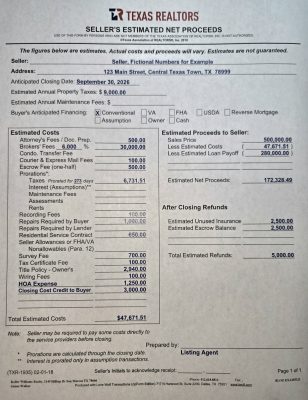
Sample seller net sheet showing how Texas home selling costs, loan payoff, and other expenses can affect estimated net proceeds. Figures are fictional and for illustration only.
Broker Costs When Selling a Texas Home
Broker compensation deserves its own discussion because there isn’t a government-set commission rate that every Texas seller must pay. Compensation is negotiable.
Depending on the agreement, compensation could involve a percentage, flat amount, or another agreed structure. The amount should be clearly established in the applicable agreement.
The Texas Real Estate Commission’s compensation guidance explains that broker compensation isn’t set by law and is fully negotiable. Your listing agreement establishes the compensation arrangement with your listing broker.
Additional compensation obligations may also arise from agreements connected with the transaction. Therefore, I won’t tell you that selling a Texas house automatically costs a particular commission percentage.
Instead, I want to look at what you’ve actually agreed to pay.
Texas Selling Costs And Offers
Texas home selling costs can also affect which offer provides the best financial outcome. Imagine receiving two offers on your house.
The first buyer offers more money but requests substantially greater concessions. Another offer might have a lower price with fewer seller-paid expenses.
Which one leaves you with more money? We can’t answer that question accurately by comparing sales prices alone.
I prefer preparing estimated proceeds for competing offers when those differences matter. That lets my seller see how each offer could affect their bottom line.
Of course, money isn’t always the only consideration. Closing date, financing, contingencies, and other contract terms can matter too.
I discuss offer evaluation and the other stages of a sale in more detail in my Texas Home Selling Process: Complete Step-by-Step Guide.
Texas Home Selling Costs: Title
Title insurance is an important exception when discussing variable Texas home selling costs. Texas regulates title insurance basic premium rates.
The Texas Department of Insurance’s current title rate schedule shows the basic premium rates effective March 1, 2026. Consequently, the basic premium isn’t a charge one title company simply discounts to compete with another company.
Other title and closing charges are different. Those expenses can vary depending on the company, services, and transaction.
The Texas Department of Insurance’s title insurance guidance specifically explains that consumers can shop for different escrow fees or closing costs.
This distinction is important:
Texas regulates the title insurance premium. That doesn’t make every closing-related charge identical.

Closing is where the financial pieces of a real estate transaction come together. Texas home selling costs can include title expenses, tax prorations, negotiated compensation, concessions, and other transaction-specific charges.
Texas Title Policy Examples
Because Texas regulates the basic premium, this expense can be calculated using the state’s current rate schedule. For policies from $100,001 through $1 million, the current calculation starts with $780.
Then, 0.00494 applies to the amount exceeding $100,000. Using that formula, a $500,000 policy has a $2,756 basic premium.
At $750,000, the basic premium is $3,991. A $1 million policy produces a $5,226 basic premium.
Those examples use the Texas title insurance basic premium rates effective March 1, 2026. Applicable rate rules or credits can affect particular transactions, so I recommend checking the current schedule when preparing an actual estimate.
The contract also matters because the buyer and seller may negotiate who pays the owner’s policy premium.
Other Texas Title And Closing Costs
A regulated title insurance premium doesn’t mean two closing statements will contain identical charges. Other title-company and escrow-related expenses can vary.
That’s why I separate the regulated title premium from other title and closing expenses when discussing Texas home selling costs. We can calculate the applicable basic premium while other charges should come from the actual company and transaction.
This approach produces a more useful estimate than assigning every seller a generic closing-cost percentage.
Texas Home Selling Costs: Taxes
Property taxes can have a significant effect on what a seller receives at closing. However, there isn’t one standard Texas seller tax expense.
The property’s taxable value matters. Applicable exemptions and taxing jurisdictions can also affect the numbers.
Closing date makes a difference as well. Prorations allocate certain expenses between the parties according to the contract and transaction.
Because every property is different, I want to use property-specific information when estimating these amounts. The final settlement figures will show the amounts applied at closing.
Individual tax questions may require advice from a qualified tax professional.
Mortgage And Lien Payoffs
Your mortgage payoff isn’t technically the same thing as the cost of selling your house. Nevertheless, it can be the largest deduction from your proceeds.
Suppose your house sells for $500,000 and you owe $300,000. That obligation dramatically changes what you receive.
The payoff amount can also differ from the balance displayed on your most recent mortgage statement. Other liens may further affect your proceeds, and certain obligations might need resolution before clear title can be transferred.
That’s why I want to know about mortgages and known liens early. Finding an issue shortly before closing is much harder than identifying it before listing.
Texas Home Selling Costs: Surveys
Surveys provide another good example of variable Texas home selling costs. Some transactions can use an existing survey, while others may require a new one.
If a new survey becomes necessary, prices aren’t standardized across Texas. Surveyors can charge different amounts.
Property size, configuration, improvements, access, and required work may influence pricing. A small subdivision lot isn’t necessarily comparable to a large Central Texas acreage property.
Contract terms also determine who has agreed to provide or pay for a survey. Therefore, I wouldn’t automatically place a fixed survey charge on every seller net sheet.
First, we determine what the transaction requires.
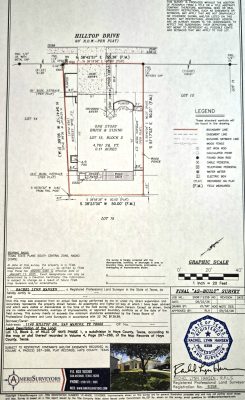
An actual San Marcos property survey illustrates why survey expenses can vary when selling a Texas home. An existing survey may be usable in some transactions, while others may require a new survey.
Inspections And Texas Sellers
A buyer’s general home inspection isn’t usually a seller expense. However, inspection findings can eventually affect seller proceeds.
A buyer might request repairs after inspecting the property. Alternatively, the parties could negotiate another solution permitted by their contract.
Sellers don’t automatically agree to every request. Some transactions close without the seller completing requested repairs, while other negotiations may involve substantial work.
Financing or appraisal requirements can create additional considerations in certain transactions. Because the outcome isn’t known beforehand, I don’t assign every seller a predetermined inspection-related expense.
Instead, we evaluate the situation when we know what we’re dealing with.

A home inspection can identify property conditions that may become part of negotiations between a Texas seller and buyer. Inspection findings don’t automatically become seller expenses.
Texas Home Selling Costs: Repairs
Repairs may be among the least predictable Texas home selling costs. One seller could spend nothing, while another homeowner might address roofing, plumbing, electrical, HVAC, foundation, or other property conditions.
Contractors don’t all charge the same amount. Even estimates for identical work can vary because of materials, timing, scope, and contractor pricing.
Pre-listing repairs create another decision. Sometimes completing work before marketing the property makes sense, while other situations may not justify the expense.
I prefer evaluating the property before recommending major expenditures. My goal isn’t to create a giant repair list for every seller.
Instead, I want to identify work that may genuinely help the sale. My Texas Home Selling Process guide also explains how I approach preparing a property before it reaches the market.
Texas Selling Costs And Concessions
Seller concessions can have a major impact on estimated net proceeds. They’re also negotiable and transaction-specific.
A buyer might request seller assistance with certain permitted expenses. Another buyer may request nothing.
Financing can affect what is permitted. Contract terms determine what the parties ultimately agree to pay.
This is another reason a higher offer isn’t necessarily the better financial offer. Suppose one buyer offers $510,000 with substantial concessions while another offers $500,000 with fewer seller-paid expenses.
We need more information before deciding which offer produces greater estimated proceeds. I’d rather calculate both scenarios than guess.
Texas Home Selling Costs: HOAs
HOA charges are one reason Texas home selling costs can differ sharply between properties. There is no universal HOA closing fee.
Different associations can have dramatically different charges and requirements. Depending on the community, expenses may involve resale documents, transfer fees, reserve contributions, assessments, or other association-related charges.
Some communities have relatively modest expenses. Others can surprise sellers who haven’t reviewed the current fee schedule.
Responsibility for particular amounts may also depend on the contract, governing documents, and applicable requirements. For that reason, I want to research HOA expenses before making assumptions about seller proceeds.
San Marcos HOA Selling Costs: Kissing Tree
Kissing Tree provides an excellent San Marcos example of how significant association-related expenses can become. Its current fee schedule lists multiple charges associated with property transfers.
The Community Enhancement Fee is especially important because it is percentage-based rather than a simple flat charge. At a $500,000 applicable value, a 0.5% fee equals $2,500.
Increase the applicable value to $750,000, and that calculation becomes $3,750. At $1 million, the amount reaches $5,000.
Those examples show why generic HOA estimates can be misleading. Certain properties may also involve additional association-related requirements.
Consequently, sellers should verify the association’s current assessment and fee schedule for their specific property before relying on an estimate.

Kissing Tree in San Marcos is an example of why sellers should investigate community-specific HOA fees instead of relying on a generic estimate.
Pre-Listing Texas Home Selling Costs
Not every expense associated with selling appears on the final settlement statement. Some costs occur before the house reaches the market.
Cleaning might be appropriate for one property. Landscaping could make a noticeable difference for another.
Certain homes may benefit from paint or flooring. Conversely, spending thousands on cosmetic work might not make sense elsewhere.
Staging is another variable expense. Some sellers can improve presentation using furniture they already own, while others may choose professional staging services.
I don’t believe every homeowner needs the same preparation package. Your house, competition, condition, price range, and likely buyers should influence those decisions.
The preparation portion of my Texas Home Selling Process guide explains why I prefer evaluating the individual property before deciding what work makes sense.
Moving Costs Matter Too
Moving isn’t technically a real estate closing expense, but sellers still need to budget for it. Professional movers can vary considerably in price.
Storage, packing materials, temporary housing, travel, and overlapping housing expenses may add to the total. Moving across San Marcos is very different from relocating across the country.
Timing can also affect costs. A seller needing temporary housing between transactions may incur expenses unrelated to the settlement statement.
I think those numbers belong in the homeowner’s broader financial plan, even when they aren’t technically selling expenses.
Home Warranty Expenses
A residential service contract can become another transaction expense, although not every sale includes one. A buyer might request that the seller pay for coverage, or the parties could agree to something different.
Providers, plans, and optional coverage can have different prices. For that reason, I wouldn’t automatically assign every seller the same home-warranty expense.
If an offer includes that request, we can add the actual proposed amount to our analysis.
Additional Texas Selling Costs
Other Texas home selling costs can appear because every property has its own history and circumstances. Liens, estate matters, special assessments, association balances, or document charges might affect a particular transaction.
Acreage properties can present different considerations from subdivision homes. Waterfront properties may introduce another set of issues.
Condominiums can have expenses that don’t apply to typical single-family properties. Inherited real estate may bring additional considerations as well.
Consequently, saying “it depends” isn’t avoiding the question. The useful part is determining exactly what it depends upon for your property.
A $500,000 Texas Home Selling Example
Let’s consider a hypothetical Central Texas home selling for $500,000. I intentionally won’t assign a generic selling-cost percentage.
Instead, I would build the estimate from the individual expenses associated with that transaction:
$500,000 sales price
− mortgage and lien payoffs
− negotiated brokerage compensation
− applicable title and closing expenses
− property tax prorations
− negotiated seller concessions
− applicable HOA expenses
− survey expense, if required
− repairs or other agreed expenses
= estimated seller net proceeds
Notice what isn’t included: there isn’t a line saying, “Texas sellers normally spend X percent.”
That’s intentional. Until we know the property, agreements, contract terms, and actual expenses, one percentage creates false precision.
Why I Use Seller Net Sheets
A detailed net sheet helps me estimate Texas home selling costs using property-specific numbers. Before listing, we can include costs we already know while other expenses may need to remain estimates.
That’s perfectly reasonable as long as everyone understands those numbers can change. Once an offer arrives, I can update the calculation using its actual terms.
This becomes especially useful when comparing competing offers. A higher price might come with greater concessions, while different closing dates can also affect prorations or other expenses.
Looking at estimated proceeds provides another perspective. Ultimately, the seller chooses the offer and terms they want to accept.
My job is to help them understand what those numbers may mean.
Estimate Texas Selling Costs Early
You don’t need to wait for an offer before considering Texas home selling costs. We can identify many variables before your property reaches the market.
First, determine the approximate mortgage payoff and identify known liens. Next, investigate HOA requirements when applicable.
We can also discuss broker compensation and whether an existing survey is available. Property condition deserves consideration as well.
After walking through the house, we can discuss potential preparation or repairs without assuming every project needs completion. Title expenses and tax prorations can also be estimated using appropriate information.
Unknown expenses should remain estimates. I’d rather tell a homeowner that a number could change than pretend we know something we don’t.
If you’re beginning to consider a sale, the Walker Texas Team contact page gives you a simple way to start a conversation about your property, potential value, and estimated proceeds without assuming you’re ready to list.
Questions Texas Sellers Should Ask
Before listing, ask your REALTOR® to explain the expenses that may apply to your property. Don’t settle for one generic percentage.
Find out which costs are known and which remain estimates. Ask whether your property has unusual HOA requirements.
Likewise, determine whether a current survey exists and might be usable. Discuss compensation before signing your listing agreement.
When an offer arrives, look beyond the headline price. I recommend asking what the proposed terms could mean for your estimated proceeds.
Most importantly, don’t wait until closing to begin understanding your numbers. My guide to choosing a real estate agent goes deeper into the questions sellers should consider when deciding who will represent them.
Texas Home Selling Cost FAQs
What Are Texas Home Selling Costs?
Texas home selling costs can include negotiated brokerage compensation, title expenses, taxes, HOA charges, concessions, surveys, repairs, and other transaction-specific expenses. Not every seller incurs every cost, and the amounts can also differ considerably.
Is There A Standard Selling Cost Percentage?
No single percentage accurately describes every Texas home sale. Too many expenses depend on the property, providers, agreements, and negotiated contract terms.
Are Real Estate Commissions Fixed In Texas?
No. Broker compensation isn’t set by law and is fully negotiable.
The applicable brokerage agreements should establish the compensation arrangement.
Are Texas Title Insurance Premiums Standardized?
Texas regulates title insurance basic premium rates. Current basic premium rates became effective March 1, 2026. However, they can change over time. Always check with Texas Department of Insurance for current rates.
Other title-company or closing expenses can vary.
Who Pays Title Insurance In Texas?
The answer depends upon the contract and transaction. A regulated title premium doesn’t mean one particular party must always pay it.
The Texas Department of Insurance confirms that buyers and sellers may negotiate who pays the title policy premium.
Does Every Texas Seller Need A New Survey?
No. An existing survey may work in some transactions, while other circumstances can require or result in obtaining a new survey.
How Much Do Seller Repairs Cost?
There is no standard amount. Repairs could be zero in one transaction and substantial in another.
Property condition, negotiations, work needed, and contractor pricing affect the result.
Do HOA Fees Vary?
Absolutely. Associations can have different document, resale, transfer, reserve, assessment, and other requirements.
Can HOA Costs Reach Thousands?
Yes, depending upon the community and transaction. Kissing Tree in San Marcos demonstrates why sellers should investigate their specific association rather than rely on a generic average.
How Much Will I Net From Selling My Texas Home?
Start with the expected sales price and subtract applicable payoffs and transaction expenses. For a meaningful estimate, I recommend using property-specific numbers instead of a generic percentage.
Know Your Texas Home Selling Costs
Understanding Texas home selling costs starts with understanding your specific property. Does it have an HOA, and is there an existing survey?
What is the approximate mortgage payoff? Are there property issues worth addressing before listing?
We should also discuss compensation and potential transaction expenses. Once an offer arrives, we can evaluate its actual terms.
That allows us to move beyond asking, “What did the house sell for?”
Instead, we can ask the question that matters to most sellers:
“What am I estimated to walk away with?”
If you’re considering selling in San Marcos or elsewhere in Central Texas, I’m happy to help you work through those numbers. Understanding your options doesn’t obligate you to sell.
Sometimes knowing your estimated value, possible expenses, and potential proceeds is enough to make the next decision easier. You can also review my Texas Home Selling Process: Complete Step-by-Step Guide to see how these costs fit into the larger selling process.
When you’re ready to discuss your specific property, you can contact Walker Texas Team and we can start working through the numbers that may actually apply to you.

A Kissing Tree home previously sold by James Walker and Walker Texas Team in San Marcos, Texas. Community-specific HOA expenses are one reason Texas home selling costs can vary from one property to another.
About James Walker
James Walker is a REALTOR® and real estate broker with Walker Texas Team at Keller Williams Realty. He has worked in Texas real estate since 2008.
Based in San Marcos, James serves homeowners throughout Central Texas. His experience includes residential, acreage, farm and ranch, waterfront, luxury, new construction, and commercial real estate.
You can learn more about his background, experience, and approach on the James Walker San Marcos REALTOR® and Broker profile.

Walker Texas Team at Keller Williams Realty KW ATX—trusted real estate experts serving San Marcos, TX and the Central Texas area.